

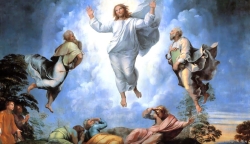
The Transfiguration is something rather unexplainable. The gospels do not tell us why this event took place. And there are many questions this magnificent event raises. Here are a few:
How and Why are Moses and Elijah present?
What is really happening to Jesus in the Transfiguration?
Why does Peter want to make tabernacles?
Why does Jesus instruct them not to tell anyone about this spectacular event?
This would be about like having your first child then getting a word from God not to tell anyone! Sound almost impossible, right?
Here is another interesting piece of information that surrounds the mystique of this event.
The Transfiguration is contained in Matthew Mark and Luke but not John. That is quite interesting because John was one of the 3 disciples on the mountain. Exactly where this event took place is not known exactly. And why this event took place is another mystery of sorts.
Many believe this event took place at night, which would have made the light even more brilliant. The word used to describe what happened is metamorphosis speaking of the change of Jesus taking the form of his heavenly glory. His appearance was white and glistening. The word used here means to flash like lightning. There have been many artistic expressions of this event. Even though we do not know all that happened it must have been a very spectacular event especially for the disciples! Show the picture here
The Transfiguration is listed as one of the five major milestones in the gospel narrative of the life of Jesus, the others being baptism, crucifixion, resurrection, and ascension. But all these milestones in the life of Jesus point to the greater aspects of what it means for His followers. Those events are bringing about our full salvation that only Christ can accomplish.
The transfiguration echoes the teaching by Jesus (as in Matthew 22:32) God is not “the God of the dead, but of the living”.
This is on full display with the presence of Moses and Elijah on the mountain.
Although Moses had died and Elijah had been taken up to heaven centuries before (as in 2 Kings 2:11), they now live in the presence of the Son of God. The fuller implication here is that the same return to life applies to all who face death and trust in the promise of Jesus. It is truly exciting and inspiring to understand that Moses and Elijah came from conquered graves and conquered death! Praise God!
To comment on the reason why Moses and Elijah were present:
Scholars suggest that Moses represented the Law and Elijah represented the prophets. Then Jesus would represent the fulfillment of the Law and the Prophets. And how are the law and prophets fulfilled?
Remember the words of Jesus, Love God with all your heart, soul mind and strength and love your neighbor as yourself. Then he further taught that on these two commandments hang what? All the law and the prophets! (Matthew 22:37-40) So in Jesus we have the fulfillment of the law and prophet which is highlighted by this glorious moment in Jesus’ life.
But here is another key part. When God spoke from heaven and said, “listen to him” this identified Jesus as the messenger and mouthpiece of God. As John put it, Jesus is indeed the Word made flesh. This statement relayed to the apostles that Jesus is the Voice of God above Moses or Elijah representing the Law and the Prophets. Jesus should be listened to, surpassing Moses by virtue of his divinity and as the Son of God. We might say that the Transfiguration literally places the spotlight on Jesus superseding all others, even what might be considered the greatest deliverer and prophet of the OT.
Now we can only imagine what it must have been like for the disciples on that holy mountain! They would never forget this incredible experience and forever value its significance.
Peter picks up the superiority of Jesus in this Transfiguration event in his letter,
16 For we did not follow cleverly devised stories when we told you about the coming of our Lord Jesus Christ in power, but we were eyewitnesses of his majesty. 17 He received honor and glory from God the Father when the voice came to him from the Majestic Glory, saying, “This is my Son, whom I love; with him I am well pleased.” 18 We ourselves heard this voice that came from heaven when we were with him on the sacred mountain. 2 Peter 1:16–18
The message is unmistakable! At the Transfiguration God assigned to Jesus a special “honor and glory” and it is the turning point at which God exalts Jesus above all other powers in creation and positions him as ruler and judge. As we put today, Jesus is Lord over all!
But the glory of the transfiguration, and the exaltation of Jesus are not all that is happening in this event. There is something else relayed in the conversation happening between Jesus, Moses and Elijah. What exactly were Moses and Elijah and Jesus talking about? Luke alone reminds us that they are talking about Jesus’ “exodon” that is, his death or departure (Luke 9:31)
Now when you hear the word exodon, what does that sound like? Exodus, right? And Moses is there with Jesus and Elijah, as the leader of the OT Exodus. The Exodus is the greatest deliverance of God’s people in the OT. So much so that it is named after the second book of the OT. But this Transfiguration event is pointing to Jesus’ death and resurrection. And guess what? This means that a greater exodus than Moses is happening through Jesus! Amazingly, through Jesus’ death and resurrection the greatest “exodon” in history will take place. Truly we can say One greater than Moses is here!
But the Transfiguration was pivotal reminder that glory would only come through His suffering and death.
I don’t think Peter understood the conversation going on between Moses, Elijah and Jesus. In some versions there is a parenthesis indicating he didn’t know what he was saying. In all honesty, I think I would have been a lot like Peter who got caught up in that glorious moment. I would be thinking, “Yes, Lord, we have arrived now! Let’s just stay here and never go back down the mountain!! Let’s just stay here and let me build some shelters”. But this is only a glimpse of glory. This is not the end of the gospel. There is much more to come. Some painful events were ahead which are not so glorious. No Peter! This is only the first half…there is a whole other half to go!
Remember, just a little earlier in the previous chapter, Jesus told his disciples he was going suffer and be rejected. Let’s look but to Matthew 16:21,
21 From that time on Jesus began to explain to his disciples that he must go to Jerusalem and suffer many things at the hands of the elders, the chief priests and the teachers of the law, and that he must be killed and on the third day be raised to life.
Much to Peter’s disappointment they had to come down from this glorious mountaintop to embrace the greater call of God and drink from a very bitter cup.
Interestingly, we see the same pattern in the life of Moses and Elijah. Moses and Elijah both had some glorious things happen in their lives on mountaintops.
For Moses it was Mt. Sanai. You remember there he received the laws written by the finger of God on tablets of stone. Can you imagine what that would have been like? Perhaps that was the most glorious event in Moses’ life up to this point? How great to encounter God in such a close and personal way! But Moses could not stay on the holy mountain. And what did he find when he came off the mountain? Bitter disappointment. The Israelites had made a golden calf and were practicing idolatry. They were carousing and practicing immorality with the laws of God still fresh on the stone tablets! Right at the base of that holy mountain Moses would see the exact opposite of the laws God placed on the stone tablets. Then Moses threw down the tablets of stone in great anger and frustration over the sins of his people (Exodus 32). Show picture of Moses here
For Elijah, it was Mt. Carmel. You remember that Elijah lived during the reign of King Ahab and Queen Jezebel. In the marvelous scene in I Kings 18, Elijah participates in what has been called the “Super Bowl” of prophets. Elijah confronted the prophets of Baal with a competition. Whose God was the true God? Was it Baal or was it YHWH or God Almighty? In the contest the false prophets were to take a bull and sacrifice it the altar. Then they would call on their god to bring down fire to consume the sacrifice. So they called on their god Baal from morning til noon. There was no answer. Elijah taunted them by saying things like, “Pray harder, maybe your god is sleeping”. “Dance a little more maybe your god is out visiting or on vacation”. They continued praying til evening, but nothing happened. Then it was Elijah’s turn. The bull was sacrificed and placed on the altar. Then Elijah tells them to dig trenches around the altar. Then he tells them to pour 4 barrels of water over the sacrifice, not once, but three times. Remember this is during a severe drought. Elijah then calls on God to bring down fire from heaven. And God answers…. Here our true God consumed the sacrifice and dried up all the water around the altar. Everyone there is utterly amazed and stunned. Elijah’s God is the true God. Then Elijah kills all the prophets of Baal. Here on Mt. Carmel, we see the glory of God in such a spectacular manner. Show Picture of Elijah here
But right after this glorious mountaintop experience, Elijah comes down from the mountain and there is Jezebel. Jezebel, whose name still carries overtones of evil to this day. She issues a death threat for Elijah. She says, by this time tomorrow, Elijah will be just like those slain prophets of Baal. Elijah now quickly faces Dejection and Disappointment. Now he is running for his life and falls into a period of depression, even asking God to take his life. What a tremendous turnaround from his glorious mountaintop experience.
Now let’s move quickly back to this mountain top experience where Jesus is being transfigured before the disciples. Like Moses and Elijah this mountaintop experience was a moment of glory? But Like Moses and Elijah, Jesus had to come down from this mountain. And what does he face? Like Moses and Elijah his faces bitter disappointment. His disciples failed in their mission to heal a young boy. His ministry was scrutinized by the Pharisees who try to make claims against his ministry. So, there is both disappointment and dejection faced by Jesus immediately following this glimpse of glory.
Yes, I think we would be like Peter and want to stay on the mountain! His desire to build tabernacles certainly implied that Peter wanted to stay and bask in the glory of God. Perhaps he thought the kingdom of God had been fully realized in this Transfiguration event? But Peter was mistaken. Peter, I believe, represents the human tendency to want to stay on the mountain where everything runs smoothly. A place where we feel secure and safe. A place where we can just enjoy the presence and glory of God. But there was still another mountain they had to climb that was not so glorious and spectacular. We all know that mountain, as Mt. Calvary. Maybe this is why Jesus did not want them to tell anyone. They misunderstood this event. And if those closest disciples misunderstood it, the masses would surely not understand it either.
As Peter then, we may struggle to understand the full meaning of the Transfiguration. But I think we can say: The transfiguration is a glimpse of glory, but only a glimpse. It may have been a reinforcement for Jesus before he endured his greatest test not so far into his future. That would be Mt Calvary and the brutal cross on which he would die. Show picture of Mt Calvary here
Before I close let me give you a couple of personal applications that stem from this Transfiguration event.
First, The Transfiguration reminds us that glorious moments give us greater assurance to face more difficult events in the future. One of my favorite hymns is Blessed Assurance. It contains the lines…Blessed Assurance Jesus in Mine, Oh what a foretaste of glory divine. There is a heavenly and spiritual assurance, a glimpse of glory, a foretaste of glory divine that God provides that helps carry us through our deepest earthly struggles and hardships.
Second, The Transfiguration reminds us of our call to discipleship where we must leave the joyful and glorious experiences to embrace difficult places where God may direct us.
In Mark’s account of this event, in the very next chapter, Jesus is confronted by a rich young ruler who asks, What must I do to have eternal life? Jesus said, You know the commandments, keep them. The young man was elated and stated, “I have kept the commands from my youth up”. He was just cruising along in life riding high on the mountain here. Then I can see Jesus like the old Detective Columbo character as the young man starts to walk away, “O, just one more thing. Go sell all you have and give to the poor, and you will have treasure in heaven”. Now Jesus did not say that to everyone. He said it to this man because he was placing his earthly treasure above God. It might be something different for you and me.
The Super Bowl was last Sunday, and I was reminded of an event that happened a few years ago, in a Disciple Bible Study Class. We were talking about some of the laws of the Old Testament and how certain laws were established to benefit those who were poor and needy and how God desired for his people to be generous with their possessions. Someone in the class asked, “Well does this mean that rather than buy an automobile that’s $45,000 or $50,000 that we should buy one that’s $20,000 and use the excess money to help those who are in need?” (Bear in mind this was a few years ago when the price of autos was much less). It was an interesting question! And I said, “Well I can’t answer that question for you. That’s a question between you and God as you prayerfully decide what you need to do. It’s an act of stewardship as to how you operate the finances in your life. It certainly made me think more deeply about my own stewardship. Later, this same person mentioned that he had tickets to go to the Super Bowl. After class some members of the class were still talking in the parking lot. I don’t know what came over me, but I decided to do have a little fun with him. I drove up beside him in the parking lot, rolled down and said, “You know, I think you ought to sell your Super Bowl tickets and give the money to the poor.” He knew I was joking with him. And that was probably not the most pastoral thing to do. But here’s the reality. Would we be willing to do that? Some of you may be thinking I would not even want tickets to the Super Bowl! And I understand that. But you know what I’m saying here. What might be a costly sacrifice for you? And each of us in our own lives must come to terms with our own call to discipleship to deny ourselves, take up our cross and follow Jesus. And this call was certainly a reality for Peter and James and John who were on that mountain and for all of us who are modern day followers of Christ.
As we come into this holy season of Lent, we usually think about things to give up. I have given up chocolate, sodas, TV, and meals in fasting. All this is good. But I want you to seriously consider not just giving up things…that is, practicing self-denial. For Lent this year you might focus on “’taking up” certain things…taking up your cross…
Some suggestions:
Spend more time with people who are hurting or infirmed
Give more of your resources to assist the poor/needy
Go to a place of ministry that is difficult for you (Your Samaria)
Take more time to read the scriptures and pray
I ask you to be open for God to direct you to those places where He may want you to go… or things he may want you to “take up” in your life. Be prayerful and let God through His Spirit, speak to you about your life and your discipleship in following Jesus into places that are beyond your comfort zone.
May we pray? Lord we cannot fathom how much you love us, but we are thankful that we can experience it. Lord, we pray as we seek to follow you that we will not just grow comfortable but answer the call to discipleship. Not just doing things that may be easy and casual, but for something that might be difficult, like taking up a cross. We pray your Holy Spirit may work in our lives as we answer that call. In the name of Christ. Amen. Altar is open for prayer for any need in your life. But I would call us to pray to seek what the Lord might be calling us to do in our own journey of discipleship, as we follow Jesus in this upcoming Lenten season.
Leave a Reply