This is the Word of God. for the people of God. Thanks be to God. You may be seated.
This is a very inspiring but challenging word today, challenging for myself and I think for all of us, especially husbands! Paul is giving instructions regarding marriage in this passage. In the fuller context of this passage of scripture he is really instructing husbands how to love their wives and wives how to love their husbands.
But in this passage, he is speaking more directly to husbands. And to all husbands here today, and for myself, yes, this is a challenging word! It logically leads to asking myself a question…and to all our husbands here today, “Do I love my wife as Christ loves the church?”
During this instruction, Paul gives this incredible metaphor of the church as the bride of Christ. Quite a powerful image. And it is an image from Genesis and the creation of the world to Revelation and the consummation of God’s eternal plan and purpose for the creation. And speaking of Revelation, John sees the eternal state of believers in Revelation 21. The eternal state of believers will have access to the heavenly city known as New Jerusalem, coming down out of heaven. And how is the heavenly city pictured? John records that it is “adorned as a bride”. This means this City will be glorious, it will be radiant, and all the inhabitants of the city, the redeemed of the Lord, will be holy, will be pure, wearing white garments of holiness and righteousness.
There is another important part of this passage. It speaks to us more directly about the nature of love. And how love is intricately tied to or related to holiness. This enriches or deepens our understanding of the true meaning of love. We emphasize love in our culture. It is glamorized by Hollywood, expressed in music and movies and saturated in our social media platform. I have mentioned this before, but the reality is that we tend to not only look for love in all the wrong places but look for the wrong kind of love in all the wrong places!
We emphasize love, but we tend to shy away from purity. We want love, but we’re not sure about this business of being without stain or blameless. This seems like a standard that’s too high, something that we cannot attain. But it is precisely what Paul is talking about here. It is the power and consequence of God’s love working in our lives and our hearts. If this is true, then many understandings of love in our world tend to be more superficial and even misguided. We may have sympathy and compassion and that is needed. But it sometimes borders on even sappy sentimentality. David Seamands called this “sloppy agape”. I’ve mentioned in previous sermons, but it bears repeating here. God’s love meets us where we are. But God’s love never leaves us where we are. God’s love is unconditional as He meets us without requirements. But God’s love also empowers us and moves us toward obedience and holiness. And in this love, we are being made more and more into the image of Jesus. Christ is becoming more and more, and we are becoming less and less. For God’s love brings about a change, a transformation of our nature. As we see this in Scripture, and as Paul writes in other places, God’s love moves us from being unholy to holy…from darkness to light…from death to life… from the power of Satan to the power of God. These are incredible consequences of the love of God working in our lives. And this is tied to holiness or sanctification.
Another great scriptural teaching about this is clearly seen with Jesus talking about the nature of love. He qualifies love by saying first that love requires obedience. In John 14:21 Jesus said this:
“Whoever has my commands and keeps them is the one who loves me. And the one who loves me will be loved by my father, and I too will love them and show myself to them.”
So, we see here that this love encapsulates a responsive obedience. Obedience to his commands and to his directions.
But in this passage, there’s another quality of this love that is also difficult to hear. Real love involves real sacrifice. Out of his great love for us Christ was sacrificed. For us to be the people God has called us to be, in order for us to be the church, the holy and blameless bride of Christ, we cannot achieve this by any action on our part. Indeed, this is a standard or status that we cannot attain on our own. It is given through the sacrifice of Jesus for us.
We know that Jesus died for our forgiveness. He shed his blood for the forgiveness of our sins. That is the gospel, but that is the first part of the gospel. Most of us are familiar with this part of the gospel. But what Paul is talking about here is what I would call the second half of the gospel through Christ’s sacrifice. The second half of the gospel is often missed and overlooked. But this is the heart of what Paul is teaching here.
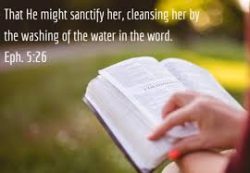
Paul writes that we are cleansed…that is, we are being made holy, through the washing with water…through the Word.
Now what is that talking about exactly? What does that mean? What is this washing with water through the Word?
Well, most of us may relate this washing of water to our baptism. Perhaps everyone here today has been baptized. If not, I would love to talk with you about baptism. But in baptism the water, the external water is a symbol of the greater work of the inward grace of God. And in that act the water symbolizes the washing away of our sins. One of the modern songs represents that aspects of the washing away of sins. There is a country song for nearly everything. Randy Travis humorously suggested the people pray for the fish in the water where a certain person was being baptized, thinking that their sins being washed away might kill the fish! But of course, baptism is only symbolic of how spiritually but no less experientially, God is washing away our sins!
But water is not only a cleansing agent. Water has a renewing quality as well. I don’t know about you, but I think there’s nothing quite as refreshing as taking a warm shower. And even this morning as I got up and my joints were stiff and then I got into a warm shower, and it was refreshing. It was renewing, not only washing away my old dead skin cells but also bringing renewal to me. This is greatly symbolic also, because we are not only forgiven but the scripture says we are also cleansed. And I think our baptism can be quite emotional because the external symbol of water is corresponding to the internal washing away or cleansing of our sins. And we feel the release of our sin and acceptance by God!
I like Wesley’s great hymn, And Can It Be? Where he says those now famous words, “My sins, oh, the bliss of this glorious thought, my sins, not in part, but the whole has been nailed to the cross, and I bear them no more. Praise the Lord! Praise the Lord! Oh my soul!” It’s not just part of my sins, but all of them are gone! What an incredible experience of freedom and joy that comes through our baptism and the washing away of our sins!
But our baptism is only the beginning, right? It’s the initiation of our journey with Christ that is meant to launch us into the greater work of God in our personal lives, through the church and to the world. This begins the process of sanctification in our lives. This is what being washed or cleansed by the Word means. But there is another perspective that I think is important in understanding the cleansing aspect of the Word.
Many think this washing of the Word is not just representing about baptism. Note what it says here. Cleansing by the washing with water through the Word. In this other perspective, the washing of the word is seen in the daily acts of devotion in the Word of God and our faithful discipleship in following Jesus.
There are two parts to this. One is the cleansing and the washing part. The other is the means of how that cleansing happens. And that is through the Word of God.
So, let’s go back to the imagery that Paul uses here as the church being the bride of Christ. And the bride is made holy through the cleansing and washing of the Word. One thing that seems very evident here is that washing is for a purpose, right? Why do we wash things? Because they’re dirty. They need to be clean. I mean, you don’t put clean clothes in your washing machine, right? Or you don’t’ put clean dishes in your dishwasher. What this implies is there is a need for washing. There is a need for cleansing to happen in our lives.
It has been my experience across the years that in our human struggle with sin there are two extremes. One extreme is those who may never really acknowledge their sin. They are good people who do not think they need to repent or acknowledge any wrongdoing. Or they compare themselves to others and think they are good. When asked if they were saved, one person simply stated, “I don’t need to be saved. I’m perfectly fine!” And on the one hand, there are those who are super conscientious about their sins and shortcomings and have trouble even forgiving themselves. They have trouble accepting the grace of God and being forgiven and cleansed. Sometimes these two people marry each other! More seriously, I find that people are operating from both these positions. But in fact, we all need this washing and cleansing to happen in our lives.
Speaking of this cleansing process and the bride imagery, in the ancient world brides often went through ritual bathing and cleansing before they were married. Remember the story of Esther when she was marrying the king? It specifies that she had a year of preparation. Six months with myrrh and six months with perfumes and preparations to be married to the king. Estee Lauder would be proud!
It was quite a process of purification that was taking place there. Well, it certainly speaks to the reality that this process takes time. It’s not a one and done thing. Rather, it is something that is ongoing. It’s a process. Thus, the Word penetrates our lives as we yield more and more to its instruction and teachings. It is the cleansing and sanctifying work of God’s Word that then penetrates the greater depths of our soul, refining and washing away sinful desires and ambitions.
The great prophet Isaiah put it so powerfully, “Come now, let us reason together, though your sins be like scarlet, they shall be white as snow. Though they be red like crimson, they shall be white as lamb’s wool.” (Is 1:18). Picture that in your mind for a moment. This is alluding to the greater work of God’s operation in our inner lives to bring about cleansing and renewal! This is what Isaiah is talking about. It is the word of God that penetrates through the darkness and despair of our mess ups and our failures. And it’s the process of cleansing and making us holy and pure in the sight of God. But again, if we reference that to our baptism, it is only the beginning point of a process that lasts our whole life long.
I couldn’t help but think of the scene in the upper room at the Last Supper. In great love and humility, Jesus took a basin of water and got down on his knees and started washing the disciple’s feet.
Any of you ever participated in a foot washing service? A few. I’ve participated in several of them, and I thought about doing this today. I thought about having a surprise foot washing service today. They’re going to bring out the basins of water in a couple of minutes. No, I’m just kidding! But when you think about it. Jesus didn’t send out a memo about his actions. He didn’t send out a messenger before that supper to say, “Hey guys, get ready, we’re going to have a foot washing service tonight.” No! It was a total surprise. Matter of fact, it was not only surprising, but it was shocking to them! They were not ready when their Lord, their Master, their Rabbi got water and started washing their dirty feet.
What did Peter do? He refused. “You’re not gonna wash my feet! No way!” Maybe he didn’t want Jesus to take that lowly position as a slave. Or maybe Peter was being prideful and refused to have his feet clean. But it seems as though there was something deeper happening here in this whole process. And what did Jesus tell Peter? Remember, this is John 13. Let’s go to the text in John 13, verse 6 and following, “Jesus came to Simon Peter, who said to him, ‘Lord, are you going to wash my feet?’ Jesus replied, ‘You do not realize now what I’m doing, but later you will understand.’ ‘No,’ said Peter. ‘You shall never wash my feet.’ Jesus answered, ‘Unless I wash you, you have no part with me.’ ‘Then Lord,’ Simon, Peter replied, ‘Not just my feet, but my hands and my head as well.’ Jesus answered, ‘Those who have had a bath need only to wash their feet. Their whole body is clean, and you are clean, though not every one of you.’ For he knew who was going to betray him. And that was why he said not everyone was clean. (John 13:6)
So what is happening here? What does this mean, really? I think this is dealing with sanctification, cleansing for the disciples, more than just foot-washing. I like what Matthew Henry says, “All by whom Christ owns and saves, he justifies and sanctifies.”
Peter more than submits after he realizes what is happening here. He begs to be washed by Christ. How earnest he is for the purifying grace of the Lord Jesus and the full effect of it. On his hands, on his head, indeed, all of who he is. Like Peter those who truly desire to be sanctified desire to be sanctified throughout. To have the whole person, with all of its powers and parts made pure. (Matthew Henry)
The true believer is washed when he receives Christ for salvation. Matthew Henry goes on to comment, “See then that what ought to be the daily care of those who through grace are in a justified state,” and that means our sins are forgiven. This is the daily washing we’re talking about here. This would be like taking a shower or bathing daily! We are allowing the Word of God to wash and cleanse us daily.
In practical terms, we may give God more limited time. Maybe we only give God a brief time in the morning. Maybe on our phone app or a daily devotional. Nothing is wrong with that. But the struggle is it can be superficial…not enough time. It’s like taking smaller doses of medicine to cure something that requires larger doses in our life. This is like taking an antibiotic to fight off an infection and you must take the full dosage even beyond when you are feeling better. Otherwise, the infection may return, and your condition gets worse.
In his great prayer in the Garden before he was arrested and crucified, Jesus talked about being sanctified. Well, another word for that is to be made holy. Those words are equated with one another here. Jesus prayed for us, for all believers in John 17 before he went to the cross and before he ascended back to God. And what is he praying for? He’s praying for believers to be sanctified.
Here’s what he says in this prayer, John 17, “My prayer is not that you take them out of the world, but that you protect them from the evil one. They are not of the world, even as I am not of the world.” Sanctify them by the truth. Your word is true. For them I sanctify myself, that they too may be truly sanctified.” (John 17:15-19)
This is what Jesus is praying for the church. For the disciples then and for disciples like you and me today. Note he prays for our sanctification by the truth and then he equated the truth with the Word of God. And I hope you see the connection here. It is the cleansing of the Word that is wiping out old attitudes, impure thoughts, selfish motives that were in those early disciples in us today. Jesus is praying that we would be cleansed from those sins and impurities. So that we can be the radiant and pure Church He desires.
One final scripture speaking about this washing or cleansing in our lives. Paul is reminding believers of the state they were in before their salvation. And then how God washed them and cleansed them from their past sins. I think Paul is alluding to his own life as someone who persecuted Christians, putting them in jail and consented to the stoning of Stephen. Paul writes, “For we ourselves were once foolish, disobedient, led astray, slaves to various passions and pleasures, passing our days in malice and envy, hated by others and hating one another. But when the goodness and loving kindness of God our Savior appeared, he saved us, not because of works done by us in righteousness, but according to his own mercy, by the washing of regeneration and renewal of the Holy Spirit, whom he poured out on us richly through Jesus Christ our Savior” (Titus 3:3–6, ESV).
Quite a powerful imagery. This cleansing and renewing work of God that transforms us. This has changed us from our former way of life. This is the ongoing work of sanctification. And this calls us to be fully open and available to God, where there are no hidden closets or spaces in our lives.
In my home state it may be more popular like the song, “I’m just an old chunk of coal. But I’m gonna be a diamond someday.” And I found out that diamonds do not come from coal. But I suppose anything is possible with God, right?
Bobby Moore was the England soccer captain who received the World Cup from Queen Elizabeth when England won the trophy in 1966. An interviewer later asked him to describe how he felt. He talked about how terrified he was as he approached Her Majesty, because he noticed she was wearing white gloves, while his hand, which would soon shake the Queen’s, was covered in mud from the field… As the triumphant captain walks along the balcony, he keeps wiping his hand on his shorts, and then on the velvet cloth in front of the Royal Box in a desperate way to get himself clean. If Bobby Moore was worried about approaching the Queen with his muddy hands, how much more concerned should we be at the prospect of approaching God? Because of our sin, we are not just dirty on the outside; our hearts are unclean. And God doesn’t just wear white gloves; he is absolutely pure, through and through.”
Today as I close this time, I wonder as we reflect over our own lives maybe there’s some areas of our lives that need to be washed or cleansed? Lord, I want to open my life for your cleansing Word to wash me, to cleanse me, even to transform me.
Whiter than snow Lord, wash me just now…While in thy Presence humbly I bow!
May that be our prayer this day. Let us pray.
“Dear Lord, thank you for the amazing quality of your word that washes us, that cleanses us, that renews us. We pray that we may open our lives, every part of who we are, and even cry out as Peter, “Lord, not just my feet, but my hands, my head, all of who I am. Lord, wash me.” I pray in Jesus’ name.”

Leave a Reply