


There are at least 6 points of instruction given in these surrounding verses. I am only going to focus on verse 16 today. Paul is instructing believers to redeem the time. Why? He includes the reason in the same sentence. Because the days are evil. Most translations interpret this word as EVIL. But it has other usages that are fitting here. Other translations may read: evil, bad, wicked, malicious, slothful.
The reality is that we are living on borrowed time. The actual word for redeem here means to ransom. It is often translated to make the best use of your time. We often use the expression today, “making the most of a bad situation”. Looking to bring some sense of redemption when things are bad or difficult. This is especially significant as we all face uncertain days here and we are all living on borrowed time.
One of my seminary professors would constantly remind us in studying the scriptures: “Context is Everything!” This is especially true regarding time.
I Context Determines How We View Time
And I find at different experiences and seasons we may be looking at time differently. We often say, “Time flies when you are having fun!” Or “where did the time go?” We want the times to last forever when we are having a great time. But when we are waiting in a traffic jam, or a long check out line, or waiting at a Dr. appointment…the time just drags…and drags…and drags. And we are asking questions like, “Lord, when is this going to be over?” (Hope you are not saying this about the sermon today!) “How long are we going to have to wait?” So our view of time is very much depending on our context.
Engineers are trying to save time. The broken hearted are looking to wish time away. Pilots are trying to make up time. Prisoners are doing time. Idlers are wasting time. So, it will depend on our context as to our concept of time. But I recognize that we all have the same amount of time of 24 hours in the day although we may not have the same amount of years on this earth. Yet the question is, “How will we spend our time?”
In my very first appointment I served 2 rural churches. Most of the people were elderly. One of the patriarchs of the larger church was having severe health issues and ultimately died. He had been married 66 years to his loving wife. He was 90 years old and had a very productive and fruitful life with much to celebrate. It was his time to go without question. And there was a great celebration of his life.
Two weeks later was quite different. One of the few teenagers in the church was pregnant. There were problems and she was taken to the hospital, anticipating a very premature birth. The birth process was very difficult. The child was born and had complications. They quickly life flighted the child to UAB Children’s Hospital. But the little girl only lasted for 24 hours. This was a very “untimely” death. It was a very troubling and grievous time. And in those moments, you question and pray and look for the right perspective. But how do you make sense of this untimely loss? I wrestled with this and looked to find a way to share during the service. Then I was reminded that God does not keep time as we do. We are finite beings limited by time and space. We live in the present, separated from the past and the future. God stands above time in an eternal dimension. The bible speaks to this over and over again. But one key verse which speaks to time and eternity is:
2 Peter 3:8 King James Version (KJV)
8 But, beloved, be not ignorant of this one thing, that one day is with the Lord as a thousand years, and a thousand years as one day.
Earlier Peter reminds us further about why we need to redeem the time. Our time here is temporary. The time we spend is fleeting. Note what Peter says back in chapter 1.
1 Peter 1:24-25 New American Standard Bible (NASB)
24 For, “All flesh is like grass, And all its glory like the flower of grass. The grass withers, And the flower falls off, 25 But the word of the Lord endures forever.”
However we may view time…wanting more time or wishing time away…trying to make up time or trying to erase time… the time we have is fleeting and temporary. So we are encouraged to redeem the time! So what does it mean to redeem the time? One of the greatest tensions in life is how we spend our time. I have put it like this:
II Counting Days vs Making Days Count
A couple years ago, my brother died. My youngest sister was with him at the Cleveland Clinic when he passed. She said that he had asked for me to lead his service which was quite difficult, as you might imagine. I had lost 2 older sisters previously. God began to deal with more seriously. When your siblings are passing away, this certainly causes you to reflect more deeply about the brevity of life itself. This event impacted me greatly. So a deeper question came, “Am I just spending time or am I really investing in time?” There is a big difference. Psalm 90 instructs us to number our days, that we may get a heart of wisdom. Again, this is not just counting days off the calendar, not just marking time, not just punching the clock. But… making sure that our time is well used and well spent. This means we are not just counting the days, but we are making the days count.
I was reminded again of the old question about “What will you do with your dash?” Most of you are familiar with this. On every tombstone is a birth date and death date and little dash in the middle representing your life. That dash is very small as it represents how quickly our lives are spent here. I want to show you a picture of a tombstone of my uncle, Junior Ball, who was killed in Korea.  He was only 19 years old. So many others like him never had a chance to have a family or have a career or have a normal life span.
Knowing that life is so brief and uncertain, it should really move us to make sure we are using our dash in the way that would reflect we are redeeming time and making sure we are making the best investments possible.
Tim Hansel wrote, “When I Relax I Feel Guilty”. Sound familiar? He indicates that if you are 35 years of age you have 500 days to live out your normal life expectancy. And how did he get that? He said once you subtract time sleeping, matters of hygiene, medical matters, eating, or traveling back and forth to work over the next 36 years, the normal life expectancy if you are at mid-life, means you have 500 days to spend. If you are 70 that would be 250 and you can do the calculations related to your situation. But in any case, that’s quite sobering. Are we investing in time and making our days count? And how do we do this? As most everything we do as Christians, we look at Christ, especially in regard how we invest our time.
III Christ’s Example of Time Usage
As Christ followers we believe and know that Jesus is our Savior and that he died to forgive us of our sins. Jesus also lived on this earth a model life for us to follow. And as it relates to time, Jesus was always in unity with the plan and timing of God. He was never ahead of God. He was never behind God. He was always in perfect unity and timing with God’s plan for his life.
In the scriptures we find Jesus was born in the fullness of God’s time (Gal 4:4). Yet we know that he was destined to die on Calvary. Often in the scriptures when they came to take him, he said, “My time has not yet come.” (John 7:6). And in the Garden when he was betrayed and arrested, he said, “My time has come.” (John 17). That first Good Friday it was in perfect timing with God that he died. And hallelujah, it was on the third day, not the first day or the second day, he rose again in perfect timing with God. So his whole life from birth to death to resurrection was in perfect unity and timing with God.
Another amazing part about this is, the part that stuck out in my mind so dramatically was that Jesus never hurried. Nowhere in the scripture will you find that Jesus hurried to do anything. The scriptures tell us at times that immediately he showed up at a place. But that’s different than hurrying. The only place that it says that he’s going to move quickly is when he comes again as the scripture reveals his words, “Behold I come quickly.” But that’s the only place. As he lived his life in harmony with the purpose of God and in timing with God he never hurried.
But I find in Christian experience that we are often ahead or behind God. We are often rushing to accomplish the next thing on our calendar or to do list. Or we procrastinate and fall way behind in the timeframe when we must accomplish something.
Robert Banks has an interesting note on Christians. He says most Christians, particularly those who live in large cities who belong to the middle class, those who have managerial or professional positions or combine outside employment with substantial household responsibilities carry many burdens. And he says Christians and people raised in the Christian setting tend to take their work more seriously than others. They place a high value on family obligations. And they are often in the forefront of community life and charitable associations all of which are very good. And he says the upshot of the commitment to work in community and family as one commentator’s quotes, “Christians are like trains. They are always on the move, always in a rush, and almost always running late.” That’s quite a statement isn’t it? Does that sound familiar at all?
Corresponding to this I observe the great irony of our time. We have so many time saving devices in our push button, instamatic, automatic world. We have so many efficient devices and so many conveniences meant to save us time. Lord have mercy, we even have drive-thru funeral parlors. But what do we do with all the time we are saving? We put more things on our calendars. We add more activities that keep us pressed and stressed and hurrying and rushing continually to get there. But in our rush and in our hustle and in our hurrying are we really accomplishing God’s purpose or greater will in our lives?
John Maxwell in his book on Leadership talks about the 80/20 principle. He indicates that 80 per cent of the work in almost any institution is done by 20 percent of the people. This is true in businesses and in church. But he also applied this principle to our use of time. 80 percent of our time is spent investing in things that have little long-term significance. Only 20 percent of our time is spent investing in things that will last or have eternal significance. (John Maxwell)
Jesus taught us in the gospel a tremendous message regarding time particularly as it relates to the making plans and considering the future and making the right investments of time.
Matthew 6:26-27
Look at the birds of the air; they do not sow or reap or store away in barns, and yet your heavenly Father feeds them. Are you not much more valuable than they? 27 Can any one of you by worrying add a single hour to your life?
A little later in Matthew 6, he continues. V31 So do not worry, saying, ‘What shall we eat?’ or ‘What shall we drink?’ or ‘What shall we wear?’ 32 For the pagans run after all these things, and your heavenly Father knows that you need them. 33 But seek first his kingdom and his righteousness, and all these things will be given to you as well. 34 Therefore do not worry about tomorrow, for tomorrow will worry about itself. Each day has enough trouble of its own.
In seeking the Kingdom first, Jesus is prioritizing focusing on things that have eternal significance. This is redeeming the time and making the most of every opportunity we have in life. But Jesus was identifying things that can prevent us from focusing on eternal things.
I think there are many distractions that prevent us from redeeming the time. Even things that might be good can prevent us from doing things that are great. We settle for less that God’s best for us and so often follow the crowd or what might be culturally popular as opposed to God’s will.
Remember the reason given for us to redeem the time? Because the days are evil… And then, I think this is teaching us that it is easy to get distracted or detoured and live our days unwisely and miss the will of God. ES Jones made popular the statement that EVIL is LIVE spelled backward. This means that we are spending our time foolishly or unwisely in the exact opposite manner of what God’s will is for us.
I used this scripture previously, but it relates so well to understanding God’s will.
Romans 12:1-2 says, “Do not let the world squeeze you into its mold but rather be transformed by the renewing of your mind that you may prove what is that good and acceptable and perfect will of God.”
If we are not careful, we can let the world squeeze us into its mold. One of the greatest images of God in the bible is that God is a shepherd. Like Ps 23… This Lord is my Shepherd. And a shepherd leads sheep. Listen carefully here. A shepherd does not drive. If you are feeling driven in your life or forced or coerced in your life, there is a good chance that it is not God. It may be the enemy driving, coercing, pushing you! But it is God that leads, that directs and has a still small voice that speaks those words of instruction that we need to hear. Are you being driven and squeezed to the pattern of the world or are you being transformed to accomplish what God really wants in your life first and foremost? This is redeeming the time by following God’s design for us and purpose for us and not be squeezed or driven by the world.
Data was collected for over 200,000 Christians in 139 countries (although most of this was in America) regarding an Obstacles to Growth survey. On the average more than 4 in 10 Christians around the world say that often or always they rush from task to task. About 6 in 10 Christians say that it’s often or always true that busyness of life gets in the way of developing my relationship with God. Christians most likely to agree were from North America, Africa, and Europe and all around the world where this survey was done. Very often we may hear someone say, “I just don’t have time.” While busyness afflicts both men and women, the distraction from God was more likely to affect men than women in every survey except North America. 62% of women and 61% of men reported busyness as interfering with their relationship with God. I was surprised by that in its essence. I don’t know, maybe the women were more honest than the men? Maybe. But the reality is still very staggering. The majority say that busyness interferes with our relationship with God. But if we are honest, we find time to do the things we really want to do.
John Wesley, the founder of the Methodist Church, had rules for preachers but they would apply to all Christians who want to redeem the time:
Never trifle away time; neither spend any more time at any one place than is strictly necessary. Be punctual. Do everything exactly at the time.
Wesley was very busy. But…he was busy in making sure that he was accomplishing God’s purpose in God’s time. He was redeeming the time! God used Wesley to bring revival to a nation and a movement that is still going on in our world today!! Amazing what happens when we are in timing with God’s direction.
Stephen Covey’s book, Seven Habits of Highly Effective People, is a classic book. He gives a little exercise that I think is quite sobering. He asks people to begin writing out their own obituary. He asks how would your epitaph read? What would you want your spouse to say? What would you want your children to say? What would you want your friends to say? What would you want your neighbors to say about your life? And he said the real clincher is that you are writing it right now. And a good measure of how you’re writing it is how you’re spending your time, the investments that you are making right now in redeeming the time. But here is a greater thought…the greatest investments we make are not our possessions, property, or positions…it is people who we influence and our testimony and witness for Christ. It has often been said…There is no hearse with a U-Haul behind it.
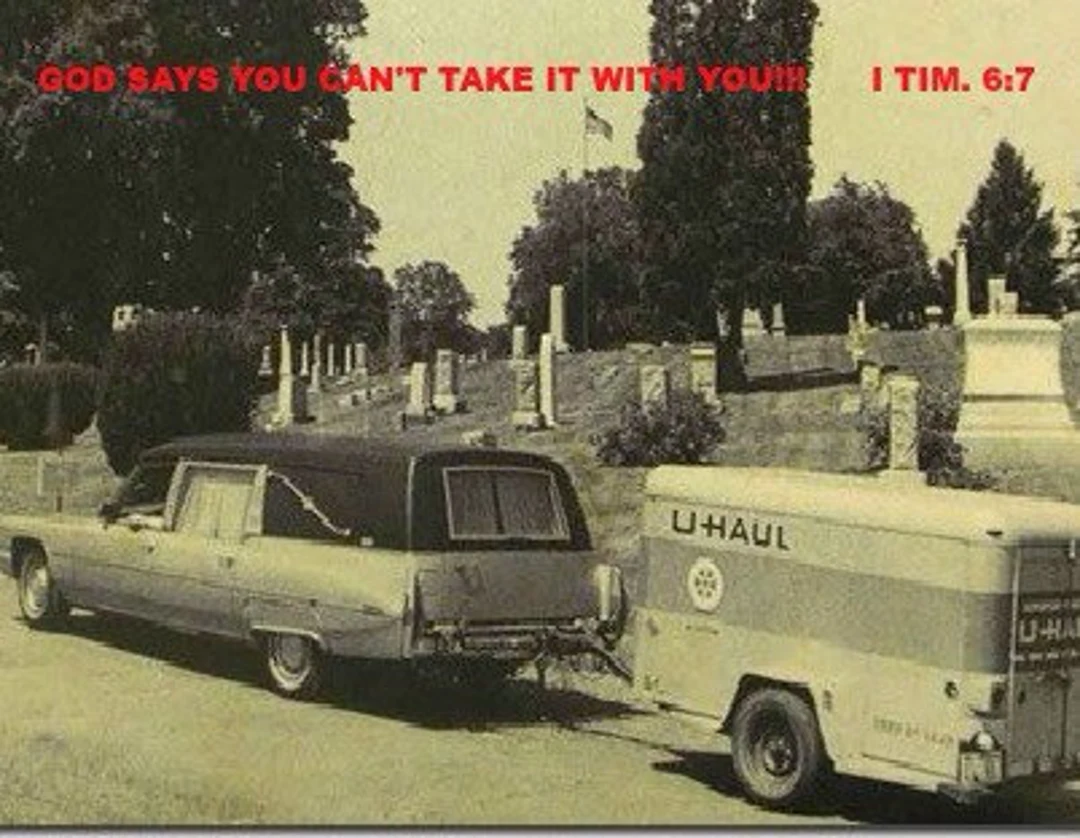
I found this picture where someone might have tried.
But the reality is…we really cannot take it with us. It is what we leave behind us that is most important and what we do for God’s kingdom and the lives of people we touch with the love of Christ.
As Billy Dean sang a few years ago…
Gonna hold who needs holdin’
Mend what needs mendin’
Walk what needs walkin’
Though it means an extra mile
Pray what needs prayin’
Say what needs sayin’
Cause we’re only here for a little while
I close simply by asking these questions about the stewardship of our time and pray that God would direct our thoughts as we contemplate how we might make the best use of the time we are given especially in this New Year.
Are we making our days count or just counting days?
Are we busy with things that are passing away or focusing on eternal things?
Are we in unity with God’s timing and purpose or are we being squeezed into the mold of the world?
I pray that God would speak to our hearts and into our own lives as we ask and answer those questions especially as it relates to our families, our children, our church, and our community. And in Wesley’s terms that we do all the good we can, to all the people we can, in all the places we can, in all the ways we can, as long as we ever can. But it’s in the divine timing of accomplishing what it is that God has for each of us to do.
Let us pray. Good and gracious God we pray that you would remind us of how blessed we are and especially with the time that you have given us. We pray as we go through this new year we would especially contemplate your work in our lives that we would respond out of love as you would lead us. Lord help us to be faithful stewards to redeem the time that you have given us. In Jesus’ name. Amen.
Leave a Reply