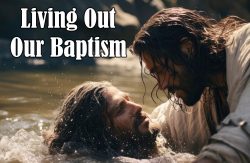
Last week was a wonderful service as we remembered our baptism. We renewed our vows and I hope all of us were encouraged by that experience. I think it is a great thing especially as we begin this next year! Today I wanted to come back to the significance of baptism look at the more practical aspects of how we live out our baptism.
First, our baptism represents:
A New Initiation
Today in the church we have two sacraments, Holy Communion and baptism. Baptism is a sacrament because Christ directly commanded it. For example, in the Great Commission Jesus said that we are to Go into the world and baptize in the name of the Father, the Son, and the Holy Spirit (Matthew 28). And today we are still following His command. The church is still operating under the Great Commission in which baptism plays a key part. But it is a sacrament and let me expound on this a little further.
The classic definition of a sacrament was given by St Augustine. St. Augustine said a sacrament is “an outward and visible sign of an inward and spiritual grace.” So, in baptism the outward sign of water indicates the inward change in the heart through the cleansing work of the Holy Spirit in our lives. Of course, the outward sign of water is of no significance without the internal work of grace. But when God’s grace is in operation it effectively changes our lives!
But here is another important part. The operation of God’s grace is something we do not control. How God makes His grace available is a mystery. The actual word for the sacrament in the original language is “mysterion” from which we get the word “mystery”. In a mystery there is a real event or experience wherein something happens, but we are not in control of it, and we cannot fully explain it. How God makes grace available is God’s action and choice. This is why God is God, and we are not. But we do have the ability to respond to God’s grace, and this is the wonderful part.
Different churches may emphasize different aspects of baptism. In some churches they practice only believer’s baptism. Herein, it is practiced only for those who can make a profession of faith in Christ. Here the emphasis is more on the person’s ability to respond. In our church tradition, we emphasize the operation of God’s grace even before a person can recognize it or respond to it. John Wesley called it Prevenient Grace that goes before our salvation. It is the process of God drawing us or wooing us into a more personal relationship with Jesus. So, in our church tradition we practice Infant Baptism because we are stressing the action of God’s grace. Let me just say here that this was part of my own theological growth to stress the grace of God even above our human knowledge or understanding. In essence, God is seeking us long before we start seeking God. He is the Hound of Heaven to borrow the lines of an old poem by Francis Thompson.
Catherine Marshall tells the story of a young man who was converted in an inner-city mission and was baptized. He shared his story. He said, God did his part. God sought me down every blind alley of drug deals. God searched for me through every petty theft I committed. God watched over me through every violent act I committed. God did His part to show me his love for me. And I did my part. I ran. And I ran. I ran from God until I could not run anymore. In the words of the great gospel hymn…He sought me and bought me with his redeeming blood. God’s grace goes before us to bring us into right relationship with God.
I mentioned this last week. But before you join almost any church no matter what denomination, there are usually two things that take place. One, we profess faith in Christ. We trust in Christ as our Savior. We believe that he died to forgive us of our sins. And two, after the profession of faith we are baptized as a symbol that our sins are forgiven and that marks us as a follower of Christ. And that’s precisely the message that John was performing. And it’s the same down through church history to us today. Remember what Peter instructed on the day of Pentecost. When they said, what shall we do?” Peter said, “Repent, believe, and be baptized and you will receive the Holy Spirit.” Pentecost is often called the birthday of the church. As this was the coming of the Holy Spirit to fill believers and begin the church. And through church history, baptism has been called a rite of initiation into the church from the Day of Pentecost forward.
There are vows and commitments that we make at our baptism. We remembered and renewed those vows last week. As John and Peter both made very clear, in baptism we are turning away from our sins in repentance. We are turning by faith to Christ. And the outward symbol of water represents the washing away of our sins. So, my baptism places me in the kingdom of God as a child of God and into his holy Church.
Now I want to share a word about the church as it relates to our baptism and our coming into the life of the church. If you were to take a theology or bible class about the church it is called, “ecclesiology”. Yes, that is a large word. In the original language the church is called the “ecclesia”. It literally means, “called out”. Through our faith in Christ, we are called out of the world to live differently. As Paul would later teach, “We are called out of darkness into His marvelous light”. Or as Jesus taught, we are to be “Salt” and “Light” in the world. So, baptism represents a NEW INITIATION into the church but even more importantly into the Kingdom of God. This means more practically that we are called to talk differently and walk differently in our world. As Martin Luther put it, we are to be “little Christ’s” in our world!
Remember the simple yet powerful message of John was repent. Turn away from your sins! Turn to God and be baptized as a symbol of your repentance and cleansing of your life! But John didn’t stop here. He went a little further. John told the believers to bring forth fruit of repentance Matthew 3:8). What is the fruit of repentance? In a nutshell, it is proving by your life, by your deeds, by your words and your actions you are showing or demonstrating true repentance. Luke expands on this by giving examples of giving a coat to someone in need. For tax collectors it was not charging more than needed to get rich. Or for soldiers not to take over houses of people or extort money from others by abusing their position. (Luke 3:8-11).
We all know of cases where people may say that have repented or that they are sorry for certain things but there is no real change of mind or change of behavior. Let me identify 2 or 3 from the scriptures.
Judas Iscariot: Felt intense remorse and confessed, “I have sinned,” even returning the money he gained from betrayal; however, his guilt led to despair rather than turning back to reconciliation.
Pharaoh: Repeatedly told Moses, “I have sinned,” during the plagues of Egypt, but revoked his promises to release the Israelites as soon as the immediate suffering was removed.
Esau: Wept bitterly over losing his blessing, but his grief was for his own loss rather than a change of heart regarding his prior choices.
But for someone who is truly repentant there is what many refer to as the “Zacchaeus Effect”. Remember the “wee little man” who extorted money as a tax collector. After his encounter with Jesus, he actively sought to restore what was lost or stolen. In his case it was repaying people 4 times over what he had taken. That is the real fruit of repentance! All this leads to the next part. Our baptism gives us:
A New Identity
Romans 6 is perhaps one of the more prominent passages dealing with baptism in the New Testament. I want to read the first few verses of Romans 6.
6 What shall we say, then? Shall we go on sinning so that grace may increase? 2 By no means! We are those who have died to sin; how can we live in it any longer? 3 Or don’t you know that all of us who were baptized into Christ Jesus were baptized into his death? 4 We were therefore buried with him through baptism into death in order that, just as Christ was raised from the dead through the glory of the Father, we too may live a new life. (Romans 6:1-4)
The first part of this teaching is that in baptism we are identifying with the death of Christ. One passage says we are buried in baptism. We are identifying with the death of Christ, dying with Christ. But the problem with sin in our life is that it’s so attractive and so alluring. The scripture teaches us that there is pleasure in sin. That is why it is so popular. Beautiful people bring an allurement for adultery as it was for David in his affair with Bathsheba. Food that is delicious but also very unhealthy – why can’t broccoli taste like ice cream? There is an allurement for gluttony. On the smorgasbord, where do you stop? Where does it end? “I bet you can’t eat just one”. It goes on and on. There’s an allurement, an attraction for land and money that creates an almost unquenchable desire for you to obtain it just like the forbidden fruit for Eve. Or the allurement for idolatry that confronted King Solomon, perhaps the wisest man who ever lived. Yet those things began to take priority in his life above God. Or like King Ahab who had to have Naboth’s vineyard even at the cost of taking Naboth’s life with the help of wicked Jezebel.
The near fatal attraction of beautiful things and beautiful lands and beautiful possessions is nearly always before us. But let’s stop for a moment and look at something that’s not quite so attractive – Jesus on a cross. It’s ugly. It’s brutal. It’s difficult to try and imagine. As a matter of fact, we are almost so repulsed that we do not want to imagine it. It’s kind of like watching starving children on television. We want to turn our heads or turn the channel. We don’t want to watch it! Every time that commercial comes on for the abused animals and the music starts, “In the arms of the angels” my wife says, “Turn the channel, turn the channel I can’t watch it!” Well, it is still a brutal reality isn’t it?
Mel Gipson’s “Passion of the Christ” gives a brutal portrayal of the passion and crucifixion of Jesus. Many of you have seen it. I have talked to some who still can’t bear to watch it. But Paul is teaching us here that in our baptism we are identifying with Christ’s death and the reason for his death. In baptism we see sin for what it is… no matter how attractive or alluring or how beautiful…or how much pleasure it brings… In essence, it is evil and it brought about the death of Christ. In baptism we are identifying with the death of Christ and why he died which is to forgive our sins. And so, our baptism identifies us with the death of Christ and our dying to our sin. Why would we want to have anything to do with that which nailed Jesus to the cross?
But there is an important part of this teaching about baptism in Romans 6:4. It says we are also rising with Christ! So, we are dying with Christ, identifying with his death and then we are being raised up with Christ to new life. “Rising up” from our baptism represents our empowerment to live a holy life, a righteous life for God. Now who raised Jesus from the dead? Answer… It was the Holy Spirit! And Paul is teaching here that it is the same Holy Spirit that allows us to live in the resurrected power of Jesus Christ.
In our Wesleyan tradition there is a special emphasis on this teaching. Through the Holy Spirit that indwells us we can live holy lives. We are to show holiness of heart and life. Dead to sin…alive to God… no longer controlled or dominated by sin but controlled by the Holy Spirit. Martin Luther put it like this, the old Adam (our sinful nature) by daily contrition and repentance is drowned and all our sins and lust die. And we are a new person living before God and righteousness and purity forever. Now we know that Luther was using that symbolism certainly of water and the drowning of the old sinful nature to bring about a new creation, a new person. That’s the powerful symbolism of our baptism.
Allow me to be more personal. My baptism gives me my identity as a kingdom citizen, a child of God. More personally today my baptism certificate is more important than my ordination certificate. Without my baptism, I could not be ordained and be a true minister of the gospel. Now every one of us here has a very important document somewhere in your household. That is your birth certificate. It gives you your name, your identity and when you started living. It gives you your identity. Well, I was named Charles William Price, Jr. on May 27, 1960, at about 7:30 in the morning. I was given that name by my parents. I’ve carried my name from West Virginia to South Carolina, to Indiana to Kentucky to parts of North Carolina to Alabama. And today I carry that name with me wherever I go and in whatever activity I engage. Wherever I travel that is my name. I am a Price. Now in a very similar manner, baptism marks us as Christ’s people. Baptism represents our new birth certificate wherein we bear the name of Christ, that Christ is in us and we are in Christ. And whether I’m playing or resting or working, whatever activity I’m engaging in my baptism informs me of who I am and gives me my true identity. All the decisions I make in my life, at home, at work, or with friends all are to be informed by my new identity in Christ. I take Christ with me wherever I go. Christ is in me wherever I go.
So, it is amazing to consider that almost 66 years later and all through the experiences of my life, all the events of my life wherever God has led me, I’m still a “Price”. That’s my identity. But my baptism marks me as a child of God, and I bear the name of Christ. It says to me that with all my roles and relationships in my life, I am a Christian. I am a Christian husband to my wife. I am a Christian father to my children. I am a Christian friend to those in my sphere of influence that I call friends. I am a Christian even to those strangers that I meet at the ball game. I am a Christian in whatever activity I am engaged in at the beach or wherever it may be. This mark of baptism separates us, identifies us as being in Christ and Christ being in us. One final note. Martin Luther remembered his baptism daily, not just once a year or in special events. But it was a daily reminder of his covenant with Christ. But he used it especially in times of difficulty. When facing doubt, depression, or the Devil, he would recall his baptism, declaring, “I am a child of God, I am baptized, I believe in Jesus Christ crucified for me”. I would recommend we use this in our own difficult encounters! We have a New Initiation as a child in the Kingdom and we have a New Identity that marks us as belonging to Christ. And all the power on earth and schemes of devil cannot remove us from this sacred position! Alleluia!

Leave a Reply