
I served in Headland just north of Dothan for a number of years. The mascot for Headland is a Ram. The Headland Rams. I tried to find the origin of the mascot but was unsuccessful. I wondered if there had been sheep in the community in its earlier history. But nobody seemed to know. I still do not know. The point being that we are not around sheep as part of our daily community. There is an Iron Rock farm in Bay Minette that have baby doll sheep. But for most of us our understanding of sheep and shepherding is minimal or non-existent.
But from the scriptures perspective sheep and shepherds have a rich and powerful meaning! For instance, some of the greatest people named in the Bible were shepherds by occupation: Abel, the patriarchs, Moses, and David, to name a few. Of course, one of the best known OT scriptures is Psalm 23 spoken at almost every funeral I have attended…to bring comfort and hope…we believe as ancient Israel knew…The Lord is my Shepherd!
He was prophesied under the Old Testament as a shepherd, Isa. 40:11; Ezek. 34:23.
In the New Testament he is spoken of as a shepherd as here in John 10. And we see this in other scriptures of the NT:
The Great Shepherd (Heb. 13:20),
the Chief Shepherd (1 Pet. 5:4),
The Shepherd and Bishop of our souls, 1 Pet. 2:25.
One of the neat experiences of one of my trips to the Holy Land was visiting the place thought to be where the angels announced the birth of Jesus. And to whom did the angels appear? Shepherds watching over their flock by night… Well, we visited that spot and saw native shepherds watching over their flocks. So, in Israel and Palestine there are still shepherds active in watching over their sheep.
Jesus pointed out at least 4 special ministries that He performs as the Good Shepherd.
(1) He dies for the sheep (vv. 11-13)
The fact that Jesus said that He died “for the sheep” must not be isolated from the rest of biblical teaching about the cross. He also died for the nation Israel (John 11:50-52) and for the world (John 6:51). While the blood of Jesus Christ is sufficient for the salvation of the world, it is efficient only for those who will believe. W Wiersbe
Perhaps the best-known bible verse is John 3:16, For God so loved the world He gave his only begotten Son that whosoever believes in Him should not perish but have everlasting life. Of key importance is that we believe or have saving faith that Christ indeed died for us.
Some time ago our neighbor was in conversation with my wife Beth. They started talking about the church and Jesus. The lady simply said, “I don’t believe Jesus died for me!” That was a rather shocking statement for Beth to hear. But Beth quickly replied, “Oh…I believe he died for me!” I am happy to say that our neighbor friend has become a believer, and her family also came to believe. Jesus is the Lamb who takes away the sins of the world but that is not effective until we believe or have saving faith.
Paul writes about this very clearly in Romans 3:24-25 and all are justified freely by his grace through the redemption that came by Christ Jesus. 25 God presented Christ as a sacrifice of atonement, through the shedding of his blood—to be received by faith.
The N.T. fulfills the O.T. You really must know the O.T. to understand the N.T. The imagery of the sacrifice of Christ finds its origin the OT sacrificial system. A spotless lamb was slain and its blood sprinkled over the altar… it was an atoning sacrifice to cover the sins of the people. The forerunner of Jesus, John the Baptist spoke very clearly identifying Jesus when he said, “Behold the Lamb of God who takes away the sins of the world”. John 1:29
So we sing in the great hymn Victory in Jesus, “He sought me and bought me with his redeeming blood”. Christ as the Good Shepherd purchases us as His sheep, and we are His because He died for us. We belong to Him, and He cares for us.
And boy o boy! Do we need caring for! One shepherd has stated, By nature, sheep are stupid and prone to get into danger, and they need a shepherd to care for them. Or we could go back to Isaiah 53 which candidly says, All we like sheep have gone astray! Isaiah 53:6 I think we all have some version of getting lost or becoming disoriented.
Mary McLaurine has an unusual condition called developmental topographical disorientation, or DTD. This means she can’t form a mental map or image of her surroundings. Unlike most people, Mary has no internal compass. Here’s how she described a typical incident of dealing with her DTD:
I was staying a friend’s home and decided to take their dog Otis for a walk. As I started back, I had no idea where I was. I was only blocks from where I had started my walk, but I was lost. Fear and adrenaline pulsed through my veins and I began to sweat profusely. My surroundings looked completely unfamiliar. It was as though I’d been dropped into the middle of a foreign land.
I hadn’t written down the address of the home where I was staying. Walking in any direction would be just a guess: Am I getting closer to or farther away? Would I have had to knock on someone’s door to use their phone to call the police? How could I expect them to return me to a place if I had no address to provide?
Fortunately, Mary found someone to guide her back to her house. With DTD there is no brain injury—no car accident, no brain tumor, or stroke. People who have this condition, basically get lost every day in the most familiar surroundings. Mary continues: “Those of us struggling with this disorder are often left with feelings of anxiety, depression, isolation, and self-doubt.” As sheep we struggle with some form of Developmental Topographical Disorientation. We used to call it simply that we easily get lost. We get distracted and stray from the fold similar to the Prodigal Son. So, we all desperately need a shepherd.
This leads to the next point.
(2) He knows His sheep (vv. 14-15)
Do you remember the story a lost sheep in Australia not long ago? A sheep named Baarack received a much-needed shearing after rescuers in Australia found the abandoned animal with more than 75 pounds of wool weighing it down. A video of his transformation on TikTok has more than 18.5 million views.
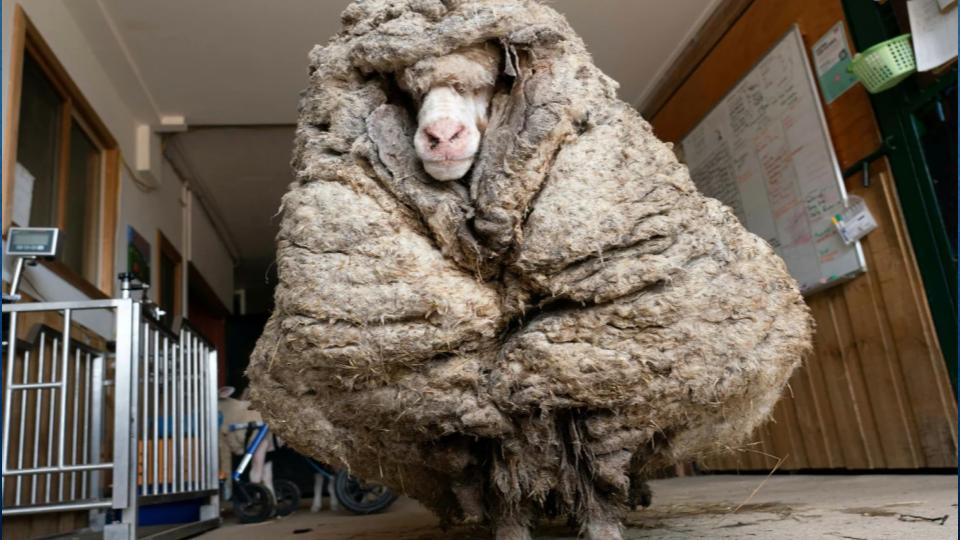
After rescuing Baarack, sanctuary staff gave him the long-overdue shearing and found the fleece clocked in at about 78 pounds. Despite his heavy fleece, Baarack was actually underweight after being sheared. The wool around his face impaired his vision, too.
I think it is appropriate to call to reference the parable of the lost sheep that Jesus taught. You remember that story from Luke 15. Jesus talked about leaving the 99 sheep in the fold to go after the one sheep that was lost. The priority was not on the 99 but on the one lost sheep. The beginning point would be to ask, “How did the Shepherd know the sheep was lost??” And then how did the sheep get lost? Did the sheep have DTD? We could venture to say the shepherd counted them daily. He knew one was missing.
But even more personally, our Lord knows our names (see John 10:3). He knew Simon (John 1:42) and even gave him a new name, Peter. He called Zacchaeus by name (Luke 19:5), and when He spoke Mary’s name in the garden, she recognized her Shepherd (John 20:16). If you have ever had your identity “lost” in a maze of computer operations, then you can appreciate the comforting fact that the Good Shepherd knows each of His sheep by name. Often my brother Pat, will say in a prayer, Jesus died for you by name. He knows your name and He calls you by name.
Christ the Good Shepherd also knows our natures. While all sheep are alike in their essential nature, each sheep has its own distinctive characteristics, and the loving shepherd recognizes these traits. One sheep may be afraid of high places, another of dark shadows. A faithful shepherd will consider these special needs as he tends the flock.
Have you ever noticed how different the twelve apostles were from one another? Peter was impulsive and outspoken, while Thomas was hesitant and doubtful. Andrew was a “people person” who was always bringing somebody to Jesus, while Judas wanted to “use” people and more concerned about the money purse. Jesus knew each of the men personally, and He knew exactly how to deal with them.
Because He knows our natures, He also knows our needs. Often, we do not even know our own needs! Psalm 23 is a beautiful poetic description of how the Good Shepherd cares for His sheep. In the pastures, by the waters, and even through the valleys, the sheep need not fear, because the shepherd is caring for them and meeting their needs. If you connect Psalm 23:1 and 6, you get the main theme of the poem: “I shall not want … all the days of my life.”
As I mentioned earlier, in Palestine today, it is still possible to witness a scene that Jesus almost certainly saw two thousand years ago, that of Bedouin shepherds bringing their flocks home from the various pastures they have grazed during the day. Often those flocks will end up at the same watering hole around dusk, so the sheep get all mixed up together—eight or nine small flocks turning into a convention of thirsty sheep. Their shepherds do not worry about the mix-up, however. When it is time to go home, each one issues his or her own distinctive call—a special trill or whistle, or a particular tune on a particular reed pipe, and that shepherd’s sheep withdraw from the crowd to follow their shepherd home. They know whom they belong to; they know their shepherd’s voice, and it is the only one they will follow.
As the shepherd cares for the sheep, the sheep get to know their shepherd better. The Good Shepherd knows His sheep, and His sheep know Him. They get to know Him better by listening to His voice (the Word) and experiencing His daily care. As the sheep follow the Shepherd, they learn to love and to trust Him. He loves “his own” (John 13:1), and He shows that love in the way He cares for them. Let’s move quickly to the next point.
(3) The Good Shepherd brings other sheep into the flock (v. 16).
In our Lord’s early ministry, He concentrated on the “lost sheep of the house of Israel” (Matt. 10:5-6; 15:24-27). The people converted at Pentecost were Jews and Jewish proselytes (Acts 2:5, 14), but the church was not to remain a “Jewish flock.” Peter took the gospel to the Gentiles (Acts 10–11), and Paul carried the message to the Gentiles in the far reaches of the Roman Empire (Acts 13:1ff.).
The phrase “one fold” should read “one flock.” There is but one flock, the people of God, who belong to the Good Shepherd. God has His people all over this world (see Acts 18:1-11), and He will call them and gather them together. We are the Global Methodist Church and we have partnership with churches in Africa, Asia, the Philippines and all over the world.
The missionary message of the gospel of John is obvious: “For God so loved the “WORLD” (John 3:16). Jesus Himself defied custom and witnessed to a Samaritan woman. He refused to defend the very narrow approach of the Jewish religious leaders. He died for a lost world, and His desire is that His people reach a lost world with the message of eternal life. You and I today are the fulfillment of Jesus words about other sheep coming to the fold! And last and most important:
(4) The Good Shepherd takes up His life again (vv. 17-21).
It would not be the gospel or good news if the Good Shepherd simple died. As Paul wrote if Christ is not risen from the dead, our faith is vain and we are still in our sins. We are hopeless! But thanks be to God, the Good Shepherd takes up his life again! He freely laid down His life…And now he freely takes up His life again. This is a message of resurrection!
Sometimes the Scriptures teach that it was the Father who raised the Son (Acts 2:32; Rom. 6:4; Heb. 13:20). Here, the Son stated that He had authority to take up His life again. Both are true, for the Father and the Son worked together in perfect harmony (John 5:17, 19). In a previous sermon, Jesus had hinted that He had power to raise Himself from the dead (John 5:26). Of course, this was a claim that the Jews would protest, because it was tantamount to saying “I am God!”
How did the listeners respond to this message? “There was a division therefore again among the Jews” (John 10:19). Note that word again (John 7:43; 9:16). The old accusation that Jesus was a demoniac was hurled at Him again (John 7:20; 8:48, 52). People will do almost anything to avoid facing the truth!
Since Jesus Christ is “the Door,” or the Gate, we would expect a division, because a door shuts some people in and others out! He is the Good Shepherd, and the Shepherd must separate the sheep from the goats. It is impossible to be neutral about Jesus Christ, for what we believe about Him is a matter of life or death (John 8:24), eternal life or death!
I found this teaching on the 23rd Psalm that I thought was very potent:
Here’s what Psalm 23 looks like when we remove the Shepherd from our lives:
1 my … I shall be in want.
2 me … me
3 my soul … me
4 I walk through the valley of the shadow of death, I will fear … me … me.
5 me in the presence of my enemies … my head … my cup
6 me all the days of my life … I will dwell
Paul Miller concludes: Without the Shepherd…we are left obsessing over our wants in the valley of the shadow of death, paralyzed by fear in the presence of our enemies. No wonder so many are so cynical …so lost… Both the child and the cynic walk through the valley of the shadow of death. The cynic focuses on the darkness; the child focuses on the Shepherd.
Can you say with confidence as David…The Lord is MY shepherd? I would invite you, if you have never done so to invite Christ into your life…Let Christ Be the Real Shepherd over your life!
Or perhaps you have strayed or may be lost or wandering and Christ may be calling your name to return to the fold.
In the words of a classic Christian hymn:
No one ever cared for me like Jesus… there’s no other friend so kind as He… No one else could take the sin and darkness from me O how much He cares for me! Amen!
Leave a Reply