
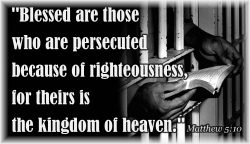
This is the last of the Beatitudes that Jesus spoke. But perhaps the most difficult one.
I might say today this is quite an intimidating sermon. Most sermons are intimidating for me, but this one is particularly so because of the subject matter about being persecuted or suffering for righteousness’ sake. So, I say from the outset my share in suffering for righteousness’ sake is miniscule at best. I do not bear in my body any marks for the cause of Christ as the great Apostle Paul and others in church history and even today around our world. We’ll talk about some of that in just a moment. And here we are in a place of comfort right on the edge of the Bay of the Holy Spirit getting ready to enjoy Easter Celebrations in a largely peaceful community. We will be watching our children/grandchildren enjoy this time, knowing the general peace that we experience. But it was not so for Christ, and it was not so for those early disciples and those to whom this word was more immediately heard.
When he referenced those being persecuted, the Greek word used means deliberate and intentional and active pursuit. It’s almost like a hunter pursuing game. Only in this case it is the person being hunted. If you can imagine being hunted as prey. Or being placed in a situation where someone is actively pursuing you to do bodily harm. Or living in an active war zone!
In one context in Acts, there was an “all-points bulletin” out for the Apostle Paul. The Jews, who saw Paul as a traitor, were searching for him in the city to kill him but his friends led him out in a basket through the city wall (Acts 9). I like how the Pulpit Commentary puts it concerning persecution, “Those who are harassed, hunted, spoiled. The term is properly used of wild beasts pursued by hunters, or of an enemy or malefactor in flight”. Again, we are fortunate to be in a place where we come freely to worship as we remember that many do not have this privilege or freedom.
The first point I want to make from this text is that this qualifying the persecution happening. What I mean by that is we are suffering FOR righteous, not evil or sinful actions.
I. The Right Reason for Persecution/Suffering
Make sure you are suffering for the right reasons. Not from poor decisions or bad habits. But because you are doing the right things or acting righteously. I have suffered in my life. Most of that has been through my own self-inflicted pain. I have made poor decisions. Or I have said things that I wish I had not spoken. What this is talking about is making sure that you’re suffering for the right reasons, not from poor decisions or bad habits but because you are doing the right thing for the right reasons for the sake of Christ.
Gill in his commentary puts it like this, “Blessed are those who are persecuted not for crimes they have done, not for unrighteousness or iniquity as thieves or evil doers but for righteousness’ sake.
Matthew Henry put it like this, “It is not the suffering but the cause that makes the person who would be a martyr. Those suffer for righteousness’ sake who suffer because they will not sin against their conscience. So, If you suffer, suffer for that which is good!
Gill is his commentary puts it like this: Blessed are they which are persecuted… Not for any crimes they have done, for unrighteousness and iniquity, as murderers, thieves, and evildoers, but for righteousness’ sake: on account of their righteous and godly conversation…
So, this persecution is real and active, and it is qualified by understanding that there are righteous reasons behind our persecution/suffering. So then why are the righteous persecuted? This moves us to the next point. And one that we may not want to hear…
II. The (Unavoidable) Reality of Persecution or Suffering
You would think people who are doing right things and good things for the sake of God would be heralded or honored. Sometimes they are honored. But why is it so often that they are maligned or harassed? Or even actively persecuted?
Listen to what Jesus said, John 15:18-21 Revised Standard Version (RSV)
18 “If the world hates you, know that it has hated me before it hated you. 19 If you were of the world, the world would love its own; but because you are not of the world, I chose you out of the world, therefore the world hates you. 20 Remember the word that I said to you, ‘A servant is not greater than his master.’ If they persecuted me, they will persecute you; if they kept my word, they will keep yours also. 21 But all this they will do to you on my account, because they do not know him who sent me.
Jesus seems to be clearly teaching that the kingdom of God and the kingdoms of the worlds are in conflict, and we are caught right in the middle of these kingdoms. The hard reality is that we should expect hardship or difficulty.
Jesus also said in the world you WILL (not might or could) have trouble…but be of good cheer I have overcome the world…John 16:33
In Luke 9:23 Jesus gave a call of discipleship, and he said to all, “If anyone would come after me, let him deny himself and take up his cross daily and follow me” (Luke 9:23). At the heart of that calling is cross bearing…which again, means we will undergo hardship.
A few years ago, our family went to Busch Gardens in Tampa Fl. They had just developed a new part of the park named AFRICA. There was a new modern roller coaster called, The Kumba… It had loops and corkscrews and major drops! And like most of the rides there was a long strung-out line to get on it. Every few feet signs were posted: Do not get on this ride if you are pregnant! (No problem!) Do not get on this ride if you have a heart condition. (Not yet anyway!) Do not get on this ride if you are under 4 feet tall (Got that one covered!) Wow! After all these signs and warnings, I’m thinking, Do I really want to get on this ride? Yes, I got on the ride. Then I found out what they called it the Kumba because after the second loop upside down I was singing…Kumba ya my Lord! Kumba ya!
Friends, when Jesus gave the call to discipleship, he was making it clear that you can expect for your world to get turned upside down! Your life will never be the same, because your life is no longer lived to please yourself but to please and honor God.
Dietrich Bonhoeffer says when Jesus told the disciples to take up the cross… He meant come and die! And most all the early disciples were martyred. BTW Bonhoeffer himself was killed by the Nazi’s in WW2. The Early Church Father Tertullian made famous the statement, in the blood of the martyr’s is the seeds of the church! Our NT gives some accounts of this:
John the Baptist was beheaded because he refused to be silent toward immorality.
Stephen was stoned to death. But gloriously, he saw Jesus at the right hand of God.
Paul was stoned, beaten, imprisoned, and finally beheaded as Christian tradition records.
Peter was hung upside down on a cross because he did not want to die like Jesus.
How about in today’s world? Unfortunately, things have not changed a lot in the world today. Christians articles relay that persecution today is very prominent. We are fortunate here, but many are not living in regions peaceful to Christianity.
Asian Access (or A2), a Christian mission agency in South Asia, listed a series of questions that some church planters have been asking new believers who are considering baptism. (Due to safety concerns, Asian Access does not mention the country’s name.) The country is predominantly Hindu, but over the past few decades Christianity has grown in popularity—especially among poor and tribal peoples. The following seven questions serve as a reality check for what new followers of Jesus might experience if they decide to “go public” with their decision to follow Christ:
1.Are you willing to leave home and lose the blessing of your father?
2.Are you willing to lose your job?
3.Are you willing to go to the village with those who persecute you, forgive them, and share the love of Christ with them?
4.Are you willing to give an offering to the Lord?
5.Are you willing to be beaten rather than deny your faith?
6.Are you willing to go to prison?
7.Are you willing to die for Jesus?
The seven questions serve as a sobering reminder for all Christians from every continent of what it might cost us to follow Jesus. These questions also help Western Christians identify with the threats faced by our brothers and sisters from other countries as they seek to follow Christ. More on this at the close of the sermon.
Of course, on this Palm/Passion Sunday we direct out attention to the central symbol of our Christian faith which is the cross upon which Jesus died. The cross remains the central symbol which represents the ultimate innocent and sacrificial suffering for us by Christ. As Isaiah put it, He was wounded for our transgressions, bruised for our iniquities, the chastisement of our peace was upon His head and by His stripes we are healed (Isaiah 53). Quite plainly, there is no Christianity without a cross. It is the suffering love of God that ultimately saves us and redeems us. As the modern song Amazing Love puts it, I’m forgiven, because you were forsaken, I’m accepted, you were condemned. I’m alive and well, your spirit is within me. Because you died and rose again.
Friends it is incomprehensible that on this Passion Sunday that we are talking about Jesus, who we believe is God the Son, was crucified on a cruel cross. Some may try to overlook or deny this truth and the very clear teaching of the scriptures about the meaning of the cross. This has been happening since the Early Church and continues today. Somehow, we want to simply hear a vibrant sermon, listen to some Christian music, get our spirit recharged and go face another week. But we must face the reality of this Passion Sunday and the original good Friday when Christ died for us. Strange as it is, persecution and suffering are the central parts of our faith!
As it was in the first century, it is hard for people in the world to understand the meaning of the cross today. Many wear cross necklaces or bracelets, or people have tattoos of the cross on them. We met a young lady who had a cross of gold filling put on one of her front teeth! On the surface, people would struggle to understand how we are glorifying a cruel instrument of death and the apparent weakness of Jesus.
Paul wrote that the preaching of the cross is foolishness to the Greeks and a stumbling block to the Jews…this really encompasses the whole world at the time. Here is what he wrote in I Corinthians 1:22-25, v22 Jews demand signs and Greeks look for wisdom, 23 but we preach Christ crucified: a stumbling block to Jews and foolishness to Gentiles, 24 but to those whom God has called, both Jews and Greeks, Christ the power of God and the wisdom of God. 25 For the foolishness of God is wiser than human wisdom, and the weakness of God is stronger than human strength. (I Corinthians 1:22-25)
Many try to oppose this or deny it or try to find another way…but they miss the meaning of Christ’s suffering altogether. It is the very plan of God for our salvation and full redemption. So much so that Paul would say that he would know nothing else except Christ and Him crucified. Paul was placing this as the most important part of our faith. Whatever else we might preach or teach, this was the one foundational truth we must never lose or forsake. But sadly, many have lost it or forsaken it. Very similar to the time of Paul, modern thought poses an easy path that is often missing the central place of the cross wherein we abandon the fundamentals of our faith. Yes, let us cling to the old rugged cross and exchange it someday for a crown! Because without it there is no salvation!
Let’s move to the last point today related to how we respond to persecution/suffering.
The Right Response to Persecution or Suffering
Nobody wants to suffer. And in our humanity, we often struggle with the right response when we do suffer. We try to avoid it. Bargain with God. We complain or curse even. We try to numb or drown the pain. But let’s look at one of the apostles who suffered persecution and death and what he had to say about it. Let’s look at I Peter 4:
I Peter 4:12-14
12 Beloved do not be surprised at the fiery ordeal that is taking place among you to test you, as though something strange were happening to you. 13 But rejoice insofar as you are sharing Christ’s sufferings, so that you may also be glad and shout for joy when his glory is revealed. 14 If you are reviled for the name of Christ, you are blessed, because the spirit of glory, which is the Spirit of God, is resting on you.
This sounds very much like Jesus Beatitude Blessed are those who are persecuted for theirs is the kingdom of God. I think Peter was listening when Jesus spoke those words! Peter says, “Don’t be surprised as though this is something new!
Look again a verse 12, “So persecuted they the prophets that were before you, Matt. 5:12. This persecution or suffering for righteousness is nothing new! This has been the case from ancient time with the prophets and messengers of God.
Think about Daniel in the Lion’s den who refused to stop praying and God closed the mouth of the lion. Think about the three Hebrew children who were put in the fiery furnace. They remained confident even if God did not deliver them. But God did. The only thing that burned up was the ropes that bound them. Hebrews 11:25 highlights the example of Moses, who chose to endure suffering with God’s people rather than enjoy the pleasures of sin for a season. This passage emphasizes the concept of prioritizing faith and God’s reward over temporary worldly gratification. I really think this is what Jesus was referring to in this Beatitude. Let’s look at modern day example.
Hassan John, a Christian pastor from Jos, Nigeria, is regarded as an “infidel” by Muslim extremist Boko Haram insurgents and has a price on his head of 150,000 Naira (about 800 American dollars). He goes to his church each day not knowing whether someone will murder him to claim the price on his head.
As an Anglican pastor and as a part-time journalist, Hassan has often been surrounded by violence and bloodshed in northeast Nigeria. He’s seen friends shot dead or injured in front of his eyes. As a reporter, he has often rushed to the scene immediately after bombings. He has narrowly escaped death himself. Hassan said, “You see it again and again and again. You get to places where a bomb [planted by Muslim extremists] has just exploded. There are bodies all over the place. You visit people in the hospital. You go back and meet families, you cry with them, you console them, you do the best you can with them all the time.”
But this violence and hatred has not stopped him from reaching out to his Muslim neighbors who need Christ. After he helped a small Muslim girl who could not go to school after her father had been killed in the violence, he started to reach out to other orphan children. Soon he was helping 12 Muslim women, then 120. Young Muslim men in the area are starting to ask if they can find help as well.
Hassan’s evangelistic outreach involves eating meals with Muslims. Hassan explained, “Now in Nigeria that is a big thing. You don’t eat with your enemy because you are afraid that you will be poisoned. Now [in an attempt to share the gospel,] Christians build friendships with Muslims; it is just so marvelous.”
I find this story quite inspiring and challenging. He was not seeking retaliation but redemption. But it reflects what is a Christian response to suffering. Again, there is a place where violence and harmful acts need to be prevented or stopped. But our response is best lived out with redemption not retaliation.
When Stephen was being stoned to death…one of his final words was, “Lord, lay not this sin to their charge…or Lord, do not hold this sin against them”. This sounds a lot like Jesus. Rember when Jesus was suffering and dying, one of his final words was, “Father, forgive them they know not what they do” (Luke 23:34). The passion of Christ is a vivid reminder that while we were yet sinners, Christ died for us.
On this Passion Sunday may we live out what Jesus has modeled for us…as we respond to our own persecution or suffering. So, Jesus said, Blessed are those who are persecuted for righteousness’ sake, for theirs is the kingdom of God! I pray we may never have to suffer in such a painful manner. But may we have grace to face our sorrows with the Spirit of Jesus!

Leave a Reply