
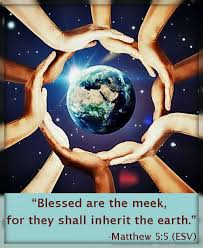
I just want to emphasize in this series that Jesus lays out some operating principles within the kingdom of God. We are to enact these operating principles in our personal lives as people in the kingdom of God. Or people who have the kingdom of God within them. Yet I find there are many misunderstandings about meekness. Meekness is a rich word. It has many different meanings. It’s hard to define or describe. But I wanted to clear up some of the misconceptions of meekness or what is popularly expressed today. So, I think we must first answer the question:
What is meekness?
The principle of meekness that Jesus referenced is very much in opposition to most of the world’s philosophies and ideologies. We hear those ideologies coming across in messages from movies and commercials and other social outlets. One of the more common leading philosophies is made popular in the sports world coined in the phrase, “Just win baby!” This is an expression by Al Davis, who was the former owner of the Oakland Raiders. He is now deceased, and his son is the owner of the Raiders now. That represents a train of thought that sounds good on the surface. In the world of sports, you must produce a “win” or you do not last very long. But this mentality or approach is really the opposite of what Jesus is talking about here concerning meekness as an operating principle of the kingdom of God. The JUST WIN BABY philosophy represents a greater ideology in our fallen world. This mentality is very pragmatic in its approach to life where the end justifies the means. Or put more simply want, it really doesn’t matter how you get there and long as you get the result you desire. This is a lot like Eve eating the forbidden fruit. It is winning at all costs. And sometimes those costs are very great!
Another related avenue of this is that we live in a world that operates on the principle of “the survival of the fittest”. Or “might makes right”. Again, these are popular notions or expressions that underlie how people live and order their lives. But Jesus is offering a radically different and counter cultural principle! Jesus said, “Blessed are the meek.”
Now when we hear the word, “meekness” we often associate it with a word that rhymes with it, right? Meekness is often equated with weakness. If I were to go around the room this morning and ask , “How would you define meekness? What would you say? What are some descriptive words you would use to describe? There is a popular dictionary and I found this definition. The secondary meaning of meekness is: Submissive, easily imposed upon, spineless, spiritless. And one I looked at even used the word, wimpish. Then I thought about it another way… We would create The First Church of the Wimpish. Now who’s going to sign up for that? Obviously when Jesus is saying, blessed are the meek he is using the word in a much different light than what we might think of it popularly today. But unfortunately, if we are honest, perhaps most of us would think of meekness in association with weakness.
A couple of nuances of this word that I think certainly need our attention and understanding as we seek to make this an operating principle of our lives and as kingdom people.
One of the nuances of this word has to do with temperament related to the emotion of anger. Are you ready for this? Greek philosopher, Aristotle talked about and championed what we call the golden mean. It is the balance in life between two extremes. It’s the golden mean, the balance between them. Lord knows we need that today. This word meekness represents a balance in our emotional life, if you will, particularly as it relates to our temperament and particularly anger. There are those who are easily angered over very small and superficial things. And on the other extreme there are those who hardly get angry about anything, even great injustices where people are wronged or people are hurt or injured. In this passive extreme, people seem detached from those troubling events. Even when tragic events unfold where innocent people get killed.
Personally, I tell you, I get angry when I see tragic events happening where innocent people are impacted or when children are neglected or abused. Those things rightfully should anger us. So how does meekness fit into our temperament? I like how William Barclay puts it: Meekness means that we are angry over the right things at the right time. That’s one of the ways we might describe or define meekness. But if we are honest, too often the things we get angry about or upset about seem to be very self-oriented. Very often we are angry about superficial things and the wrong things at the wrong time. It’s the opposite of what this word really means.
There’s a somewhat humorous story that comes out of the life of John Wesley. He was at a church meeting that was relatively small meeting and there was a discussion over some of the property at the church. It was basically a small or superficial issue. But it turned from a conversation to a debate and then the debate got heated and then people became very angry. And Wesley himself got very angry, and he stormed away from the table and went out and slammed the door behind him. He thought he was walking outside. But he walked into a closet. Now I don’t know how long he was in the closet before he came out to confront those who had angered him. Obviously, he was very humiliated at that moment.
James tells us that the anger of a person does not bring about the righteousness of God. I like William Barclay’s commentary where he makes an important distinction on this, “Anger properly exercised is always directed toward injustices of others.” It’s never so much about us personally. (Barclay) That is a very important distinction in how we understand meekness, related to our temperament and especially our anger.
It’s certainly true that Jesus modeled this and all the other Beatitudes for us. If you look at his life from the gospel accounts, He was not angry when people insulted him. He was not angry when he was ridiculed. He was not angry when people were harsh to him personally. He was disappointed and saddened. On the other hand, He did get angry when people were treated unfairly or when there were injustices around him. He got angry when they were making a profit and money changing at the house of prayer, the temple. He was angry when the Pharisee’s failed to show mercy. But note the distinction: Jesus’ anger was always directed toward injustice of others. He had the right anger at the right time and for the right reasons.
A friend of mine recently came to Christ. I was in high school with him and prayed for him for years to be in relationship with Christ. He was a very intellectual person, particularly in math. But his intellect was also a blockage for his faith. He had great intellectual doubts. He went on to become an engineer, but he remained a cynical person in his doubt. But then, after lots of prayer and intervention of friends, he finally came to Christ. He surrendered his life to Christ. Faith was born in him by God. An amazing transformation of his life took place. And when I talked with him a while back here’s what he said, Before I came to Christ, I was focused on what other people had done to me. I was focused on what other people had said to me and I was busy trying to retaliate. And I was ANGRY. And as you would imagine he was angry a great bit of the time. He went on to say, “But when I surrendered my life to Christ, God did a powerful work in my life. Now the focus in my life is not so much of what people have done to me or what other people might have said to me. Yes, that can be hurtful and injurious. But now the focus is more about what I say and what I do to others. That’s what troubles me most. So, the whole focus and direction of his life had changed.
So, one of the nuances of meekness means that our temperament is in time with God. It is for the purposes of God. We are angry at the right things at the right time directed by our actions. That is part of what it means to be meek.
Correspondently, another definition of meekness is: (you might be surprised at one of the definitions of this, even the Webster’s Dictionary) reads, “enduring injury with patience and without resentment”. This sounds a lot like my friend that I mentioned earlier and how the orientation of his life had changed. Anyone who has sustained an injury or an insult be it physical or emotional is well aware of the pain involved. Facing trials with meekness does not exclude the pain and difficulty or make it a less intense trial. But a meek person is enduring it with patience and without resentment to persevere through the pain. And this action requires great strength. So, I would submit to you, meekness means that we are operating from a position of strength not weakness.
The patient and hopeful endurance of undesirable circumstances identifies the person as externally vulnerable and weak but inwardly resilient and strong. Meekness does not identify the weak but more precisely the strong who have been placed in a position of weakness where they persevere without giving up. Meekness give us endurance to keep running the race of faith in all circumstances.
Another understanding of meekness is associated with the taming of a wild animal. Like a horse that’s been domesticated. Picture here a horse that has been broken and the rider has a bridle on the horse, and it can be steered and directed. In other words, such animals have not lost their strength but have learned to control the destructive instincts that prevent them from living in harmony with others. They are not wild and unruly creatures, but their massive strength has domesticated to be used for greater purposes.
As we apply this to our spiritual lives, Meekness means our will is completely submitted to the will of God and we submit to Jesus as our Lord. He is our Sovereign King. And we are operating within his directive power through His Spirit. His will is first above all others. As A W Tozer put it, God’s will, nothing more. Nothing less. Nothing else. Jesus modeled this for us too. He emulated that for us in the Garden in perhaps the most painful experience of his life. Before he went to the cross, he prayed, “Lord, not my will your will be done”. Friends, we can identify that as a great act of meekness. Those who express meekness have surrendered their will to the greater will of God.
Another greatest picture of this is Jesus before Pontius Pilate. In John 19 there is the ultimate showdown within the power of the kingdom of God and the power of the world. The power of the kingdom of God is represented in Jesus. The power of the kingdom of the world is represented in Pontius Pilate. And there Jesus is before Pilate’s judgment chamber and Pilate is questioning Jesus. He asked Jesus, (John 19:11). Where do you come from? Jesus did not answer. And then Pilate said, “Do you refuse to speak to me? Don’t you realize I have power to either free you or to crucify you?” And Jesus answered, “You would have no power over me if it were not given to you from above”.
Think about this as you review this scene. Jesus’ position doesn’t sound like a position of weakness to me. It sounds like a position of ultimate power and strength. Here we learn that meekness does not mean powerlessness or being spineless or wimpish. NO! But in meekness our power and our authority are yielded for the greater purpose of God.
One other scripture I want to reference today, and I debated about sharing this with you. Matthew 10:16. Jesus said I’m sending you out like sheep among wolves. Therefore, be shrewd as snakes and innocent as doves. KJV – Wise as serpents and harmless as doves. Jesus identified himself as a shepherd and more than a shepherd, He is the Lamb of God who offered himself for us for our world. Jesus remained the Lamb of God even when he was surrounded by wolves. He never stopped being a lamb. Jesus says, I am sending you out like sheep among wolves. Please note here that Jesus does not say we are to become like a wolf. That’s what the world would want us to do. That’s what our nature may call us to do. But that’s not what Jesus is calling us to do. Meekness means we are a sheep. When we have committed and submitted to following the purpose of God for us. It does not mean that we are passive or spineless or cowardly. But it means that we use our influence, our ability our power, our gifts, our talent under the control of God. I think it really equates to what the three simple rules of Methodism. Do no harm. Do good. Stay in love with God. Be a sheep in every circumstance. Now let’s move quickly to the other part of this beatitude.
Jesus said, The meek will INHERIT the earth. Those who submit their lives to God’s will inherit the perfect kingdom coming to earth. It is already breaking into the earth through Jesus. But there is going to be a new heaven and earth. Apparantely, Jesus is talking about the meek who will inherit the new earth. Herein there may be a great reversal of fortunes. The humble and meek will be exalted and those who exalt themselves will be humbled. As in the time of Jesus the mountains will be made low and the low places exalted. It is not just geography! But a reversal of people and positions. Maybe God will have His own DOGE team! Sorry, did not want to be political.
General Peter Pace was a former chairman of the U.S. Joint Chiefs of Staff from 2005-2007. He told a story when he was in Vietnam. He was serving as a Captain. His platoon was out on patrol. One of the young men in his platoon was a Lance Corporal who was shot by a sniper and killed. He was a machine gun squad leader. After his friend was killed, Captain Pace grew very angry about what had happened and was going to call in an artillery strike on the village. And then he looked over at his young Sargent who was staring him down. He didn’t say a word to him, but he was staring him down as if to ask, “What are you doing?” And at that moment he said he had to call off the artillery strike. And they went on foot and swept the village which they should have done in the first place. They found nothing but women and children in the village. The sniper had long gone. Now General Peter Pace said that was a life-changing moment for him. He yielded his authority to a higher moral authority. He saved people. That’s what Jesus is saying and that’s what he’s calling us to do. He had the power and ability to bring great harm, but he used his power to save life and bring about a great redemptive end.
I want to close here by saying that this principle of meekness is for everybody. Some of you here today may be saying, “Well this is not who I am”. Or, “This s is not how I’m wired”. Well maybe God wants to change your wiring! God can do this you know!
Meekness is a fruit of the Holy Spirit. And as a fruit of the Holy Spirit this means that God wants everyone to bear this fruit in our lives. It’s not an optional character trait. It may come easier for some people, but it is for everyone.
And meekness is a kingdom principle. If the kingdom of God is within us, we will operate by the kingdom principle of meekness. God wants us all to have this as his kingdom people. So, I just want to invite us to do that. Wherever we are. Maybe like my friend I mentioned a moment ago, this might be a beginning point in your journey. Blessed are the meek for they will inherit the earth. As I close today some of you may want to spend some time in prayer. Make an altar of your chair. Give God the opportunity to at least begin the work to have the fruit of the Holy Spirit and have this marvelous kingdom principle in your life.
Let’s pray. Lord we’re only beginning to understand the principles within your kingdom. And Lord we’re saturated with the culture and the world that is the very opposite of what you want for us. And so often Lord we conform to the world, to the pressures of the world. We pray that through your Holy Spirit you may continue to direct our lives that we may live out the principles of your kingdom and the fruit of your spirit. That we might be meek even as our Lord and experience the promise of blessing to come to those who are willing, even to lose their lives for your sake so that they may save it…all for your kingdom and glory! In the precious name of Christ, Amen.

Leave a Reply