

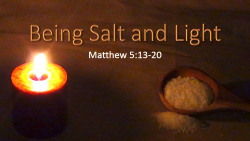
Most of us are probably familiar with this scripture. It has within it some key concepts of our Christian faith. Jesus said we are to be salt and light. In the larger context of this teaching in Matthew’s gospel, it is part of the Sermon on the Mount. This larger body of instruction includes many great teachings of Jesus to a larger group of people like I am speaking to you as a congregation. But there may have been an even greater number of people gathered to hear Jesus. The apparent purpose of Jesus preaching and teaching was to help people understand what it meant to follow him or be his disciples. Their identity was tied up with what Jesus is talking about here. Some have suggested that Jesus is teaching about principles of the Kingdom of God and how we are to live as Kingdom people.
I’ve read through this many times through the course of ministry across the years and continued to re-read it in preparation for the sermon today. Again, these terms are so familiar to us but I want to expound on these images today. But before I get there, I want to comment on something that came as a fresh insight into this teaching. It is a reference to the time or tense in which Jesus gave this teaching. I would place it in terms of being:
Present vs Future Oriented
Here these words of Jesus again.
Matthew 5:13, “You are the salt of the earth”.
Matthew 5:14, “You are the light of the world”.
Notice that Jesus is being very present tense oriented. He’s referencing how his followers are to live in the present context, in the here and now! The reason I say this is because so often we associate the purpose of salvation primarily as a future event. The bottom-line is that we are going to heaven when we die. Now that is certainly a vital dimension of our salvation. Jesus does promise us abundant and eternal life. But this teaching of Jesus is focused primarily on the present not the future. Salvation certainly involves the assurance of going to heaven when we die! But our salvation also incorporates what we do in the here and now. We are the salt of the earth now! We are the light of the world, now! Our salvation is both a future promise of the glory that will be revealed in eternity AND it is also a present reality of how we live our lives on this earth now as followers of Jesus Christ.
And in this teaching Jesus is emphasizing how we live NOW as His followers. So, let’s look at these images of salt and light for the bulk of this sermon.
WE are called to be SALT.
We may wonder why Jesus used this analogy. What is significant about salt? And if you look up information about salt you discover that it was used in multiple ways. I want to mention 2-3 today.
First, Salt Preserves
In the Old Testament salt was used in the giving of sacrifices to God. (Leviticus 2:13) The Hebrews were instructed to give salt with their offerings. Many believe the salt was a symbol of their strength and truthfulness of self-surrender as they declared their loyalty and dependence on God.
We also know there were salt covenants in the Old Testament. It was a transference of salt that ratified a covenant. It was almost like a ring at a wedding ceremony. If two parties entered into an agreement, they would eat salt together in the presence of witnesses, and that act would bind their contract. King Abijah’s speech in 2 Chronicles mentions just such a salt covenant: “Don’t you know that the LORD, the God of Israel, has given the kingship of Israel to David and his descendants forever by a covenant of salt?” (2 Chronicles 13:5) Here, Abijah refers to the strong, legally binding promise of God to give Israel to David and his sons forever.
Here is another example. Since the Levitical priests did not have land of their own, God promised to provide for them via the sacrifices of the people, and He called this promise of provision a “salt covenant” (Numbers 18:19). Salt has always been known for its preservative properties, and it is also possible that God instructed the use of salt so that the meat would last longer and taste better—and thus be of more value to the priests who depended upon it for their daily food.
My grandmother used to salt cure meat. We even have salt cured hams in grocery stores today. This preserving quality of salt is associated with truthfulness and honest dealings in relationships. Interestingly, the word “salary” comes from an ancient word meaning “salt-money,” referring to a Roman soldier’s allowance for the purchase of salt. Someone who earns his pay is still said to be “worth his salt.”
This principle of honesty and truthfulness or integrity may be one of the principles Jesus was referencing when he called us the salt of the earth. Here’s another quality of salt.
Second, Salt Purifies
We hear about people pouring salt into wounds. And that image is more negative in its connotation because it’s painful to think about pouring salt in a wound. But as we know it is often painful experiences like surgery or resetting a broken bone that helps bring healing to us. More commonly we use salt or saline rinses when we have a sore throat or nasal congestion. Others who struggle with allergies use a saline solution to help clear their sinuses. I know this is a common practice this time of year for a lot of folks. But salt solutions are used to help prevent further infection and to protect bacteria from collecting. It is a cleansing and purifying element. This may be one aspect of why Jesus said that we are the salt of the earth. We are part of a purifying element in our world.
Third, Salt Seasons and Saturates
I think almost everyone has salt in their home. You probably have a salt and pepper shaker on your table or in your kitchen. (Show pic of saltshaker here) Most restaurants have salt and pepper shakers. And when you sit down to eat in a typical meal you grab that saltshaker and you sprinkle it over your steak or your green beans or your mashed potatoes. Well, I’m hungry now! But here is the amazing part! When you sprinkle those little salt granules over the top of your food, what happens? Those salt granules melt or saturate into the steak and the green beans and the mashed potatoes. Salt absorbs into food or drinks and gives a great flavor. This is especially true when you sprinkle salt on certain items like watermelon. (Show pic of watermelon here) The salt textures into the food substance creating a wonderful taste and flavor. Watermelon, especially ones that are a little underripe or just not that tasty, have a faint hint of bitterness and tart underneath all the sweet. Salt naturally cuts through those bitter notes, making the sweetness stand out and you get the perfect sweet and salty taste. It’s like Popeye’s Chicken… “it makes your mouth feel happy!”
Now I think one great spiritual aspect of this salt saturation analogy is that it represents the saturation of God’s grace in our lives. As salt is sprinkled over food substances and internalized into that food item so the grace and love of God (and we’re good Methodists) are sprinkled into our lives.
Paul mentions this in Romans even in larger terms. He said, “The love of God is shed abroad in our hearts by the Holy Spirit.” (Romans 5:5)
I think what Jesus is talking about here is like salt is absorbed into food items this would correspond with the internal work of God’s grace and love of God sprinkled into our hearts. This saturation of grace helps shape and form who we are. The grace and love of God get involved in our thought process. The grace and love of God get involved in our emotions and our feelings. The grace and love of God get involved in our will and determination. It’s a complete saturation of the grace of God in our lives that make up the internal aspect of who we are. That is like the dynamic quality of salt.
One of Charles Wesley’s great hymns, “Jesus Thine All Victorious Love” portrays this great truth so well. It says “Refining fire run through my heart illuminate my soul. Scatter thy life through every part and sanctify the whole.” When Jesus is talking about salt I think he’s talking about the internal experience of his grace that is scattered through every part of our lives, incorporating our whole being.
We talk about people today being the “salt of the earth”. Aunt Susie was the salt of the earth! Grandpa Joe was the salt of the earth! Sister Mary was the salt of the earth! Well, what do we mean when we say that? It is hard to define this precisely. But I think what we mean is these people are exemplifying and modeling what Jesus is teaching here. I think these “salt of the earth” people would be people who have read their Bibles. Those people have spent much time in prayer with God. Those people are devoting themselves to understanding what Jesus is teaching in the Sermon on the Mount and have internalized those things in their life. The love of God is shed abroad in their hearts by the Holy Spirit as salt is absorbed into food and it flavors their whole life. It saturates their whole life. And it is unmistakable in how they look and act like Jesus.
But as good as this is…Let me be quick to say that Jesus didn’t end with salt. He didn’t end with just the internalization of His grace in our lives. But Jesus was very quick to say, “You are the light of the world”. And if we would equate salt as the internal work of God in our lives then light is something that is visible, not hidden or unseen. Light is something that is very external. So, if we have the grace of God internalized as salt in our lives, Jesus is saying that it is not kept there but rather it is to bring about a demonstration of light to the world around us. The love and grace of God is meant to be shared deeply and profoundly with others. This is very closely related to faith and good works.
James puts it like this, 14 What good is it, my brothers and sisters, if someone claims to have faith but has no deeds? Can such faith save them? 15 Suppose a brother or a sister is without clothes and daily food. 16 If one of you says to them, “Go in peace; keep warm and well fed,” but does nothing about their physical needs, what good is it? 17 In the same way, faith by itself, if it is not accompanied by action, is dead. (James 2:14-17)
I think what Jesus is talking about here is that The internalization of his grace as salt represents the ROOT of our faith. And the works that issue out of our faith are demonstrated externally as light to the world are the FRUIT of our faith. And James is very practically applying this to the people of God in how we operate in the world.
I think sometimes we may think what we do is small or insignificant. And that we might not be engaging and doing great or larger things. But I like what Mother Teresa said. “Not all of us can do great things but all of us can do small things with great love.” Isn’t that a great statement? That’s become sort of a paradigm of life for me.
I know I’ve shared this story with you but indulge me as I share it once more. It relates well to what Jesus is teaching here. When I was a freshman in high school my parents separated. I chose to live with my father. He was physically disabled with rheumatoid arthritis but at this point was still mobile. It was a Saturday morning in mid-July, and it was extremely hot! I went out on the porch which was a familiar spot for my father. He was looking out across the large creek bottom below our house that was about six acres in size. I followed his gaze down the creek bottom and saw a gentleman there. The gentleman had been cutting the weeds with an old-fashioned mowing scythe. (Show picture of mowing scythe) His name was Mr. Gore. I knew him as I had seen him working in previous places as a general laborer. He was not well educated but a hardworking man who would often do small jobs just to eke out a living. The landowner hired him to cut the weeds out of that bottom. My father had been watching him from early morning labor in the field. Then my father turned to me and said, “Son, Mr. Gore’s been in that field all morning and far as I can see he doesn’t have any food or any water. I want you to go into the kitchen and make him a sandwich. There’s a thermos jug on the wall shelf. Get it down and fill it with water and take him the sandwich and some water.” And without questioning or making excuses I went to the kitchen and made Mr. Gore a sandwich. I filled the jug with ice water, and I walked down to Mr. Gore. He was wringing wet with sweat. He pulled a rag out of the back pocket of his denim overalls and wiped the heavy sweat from his brow. He looked over at me and said, “Are you Red Price’s son?” Before I could answer he said, “I know your father. He’s sitting up there on the porch, isn’t he?” And he sent you down here to bring me this food and drink, didn’t he?” I answered, “Yes, that’s my father. And yes, he sent me to bring this food and water to you.” Mr. Gore expressed great thanks that I brought him the food. And further, he thanked me for the water. Then he told me to tell my father how grateful he was for helping him at that critical time because he was hungry and thirsty. I said, “Yes sir, I’ll pass the word along to him.” Now that action was a pivotal moment in my life. It was not a big action that required a lot of sacrifice. And that action did not end world hunger. But it did end hunger for one man. It was a simple act done out of compassion, stemming from seeing a need and reaching out to fill that need. As I reflect over that morning and its greater impact on my life I was reminded of Jesus’ words, “As the Father has sent me so send I you.” (John 20:21)
What might it look like for us today? Well, there are any number of possibilities. Maybe as a volunteer at Prodisee Pantry or Kidz Eatz? Or helping bring meals to Ronald McDonald House? Or helping bring meals to someone who is having a hard time at home? Just doing small things with great love. Here is where the grace and love of God like salt that’s been sprinkled in us finds its way out to acts of love shining like a light to bring glory to the Father. As Jesus said here, In the same way, let your light shine before others, that they may see your good deeds and glorify your Father in heaven. (Matthew 5:16)
May we pray? Lord help us now that we might become agents of your grace and love where we are indeed the salt of the earth and light of the world. In Jesus’ name. Amen.
Beautiful song and singing by the choir.
A wonderful message, Pastor Bill.