
As we think about the Church as a Temple and each of us being living stones…I could not help but think about the significance of stones or rocks in the biblical history and major events that involve rocks or stones.
In the OT book of Joshua 4 there is the amazing story of the Israelites crossing the Jordan River to enter the Promise Land…finally! Remember they wandered for 40 years!
The OT lesson focuses on the placing of the 12 stones taken from the Jordan riverbed while the waters were parted for Israel to cross over to inherit the Promised Land. These 12 stones would serve as a monument for future generations to see and ask, “What do these stones mean?” It is a piece of history that is significant to the identity of the Hebrew people and the faithfulness of God. The Israelites were finally getting to cross the Jordan River into the Promise Land, but they went into the Promised Land the same way they came out of Egypt…delivered by the mighty Hand of God. The 12 stones were meant to memorialize this moment in history. It served as a great point of convergence between the past and the future. The stones represented the power and faithfulness of God. And the stones were placed so that succeeding generations would remember what God had done in previous generations and to take confidence that this same God will move and intervene in our generation and in the future as He has in the past. He is the Way Maker, Miracle Worker, Promise Keeper…as the modern song puts it.
Interestingly, in this pivotal event God caused the Jordan river to part and the Israelites went through the dry riverbed. Amazing to consider that the river was also at flood stage when this happened. And guess who the last people were to leave the riverbed?? The answer is: the priests. The priests carrying the Ark were the first to go in and the last to go out! When the priests set their feet on the riverbank, AFTER everyone else had crossed over, the river Jordan went back to its’ flooded condition! The waters went back in place.
While we are in a new church here. I think it very appropriate that we remember our history and the foundational events that have brought us to be the people of God called the church.
But the connecting point between these two stories has to do with God’s people and the central focus on the priesthood.
In our NT scripture, Peter uses the imagery of Christ being the cornerstone…But then he uses the imagery of all believers being “living stones”.
No doubt Peter was thinking about the physical temple and how stones were laid on top of each other to make the structure solid and what people thought would be lasting.
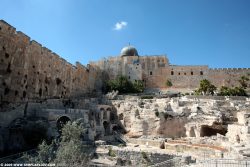
During the time of Jesus, the Herodian Temple was a marvelous structure. It was one of the most beautiful buildings in Jerusalem, if not in the world. Show pic of temple here On one occasion, the disciples drew attention to the large stones that made up the temple in Luke 21:5, some of his disciples were remarking about how the temple was adorned with beautiful stones and with gifts dedicated to God. But Jesus said, “As for what you see here, the time will come when not one stone will be left on another; every one of them will be thrown down.”
History records that this marvelous temple was destroyed in AD 70 by Roman General Titus. Of course, Jesus on another occasion referenced that if the temple was destroyed it would be rebuilt in 3 days. Of course, the temple Jesus referred to, was His Body (John 2).
Perhaps this is pointing us in the direction that the temple of God is first and foremost, spiritual in nature and centered upon the Lordship of Jesus Christ. It is our confession of Jesus which places us into the real temple of God which can never be destroyed. This certainly parallels Jesus words that the gates of hell would not prevail against the church!
But what about the imagery of living stones?? Quite a paradox, as stones are lifeless and have no normal life functions. So what about living stones? No doubt this is connected to the event mentioned last week. Let’s look again at this passage in Matthew 16:15-19
15 He said to them, “But who do you say that I am?” 16 Simon Peter answered, “You are the Messiah, the Son of the living God.” 17 And Jesus answered him, “Blessed are you, Simon son of Jonah! For flesh and blood has not revealed this to you, but my Father in heaven. 18 And I tell you, you are Peter, and on this rock I will build my church, and the gates of Hades will not prevail against it. 19 I will give you the keys of the kingdom of heaven, and whatever you bind on earth will be bound in heaven, and whatever you loose on earth will be loosed in heaven.”
I also mentioned last week that the interpretation of this passage has been divided in church history. The Catholic Church sees this as the beginning of the Pope and Peter being this rock. Protestant churches see the confession of Peter as being the rock of the Church. Peter himself was a PETROS, rock, who confessed Christ. He became a “living“ rock or stone through that confession. So, all believers who make that confession become just like Peter, living stones, fit together by God to make up a holy temple!
Now there are many implications of this imagery. One is given by commentator William Barclay. This imagery means that solitary Christianity is impossible. One stone, or one rock does not make up a temple or church. Like the bricks making up any home or commercial buildings, they are stacked on top of each other and mortared together to make a solid structure. Using the imagery of Peter, this means, much like the memorial stones placed by Joshua, the past, and those who have gone before us are stones upon which we rely and depend. And now our generation of “living” stones are being placed on those who have gone before us. We did not get here alone, and we cannot make up the church by ourselves. We rely on the previous living stones who have gone before us. This creates a sense of humility and gratitude. But this means that we are all placed around Jesus, who is the cornerstone. More on this in a moment.
The other part of this has worship implications in our present context. We may have private worship in our homes, at the beach, at a park, etc. But as living stones we are placed “TOGETHER” with other living stones to create a holy temple for God.
Note also the passive language that is used in verse 5… NRSV reads, “let yourself be built into a spiritual house, into a holy priesthood…” Just an observation here… stones do not move by themselves or on command from us, right? I mean you can call your dog…Or your cat…Good luck with that one! Or you can call your friends and neighbors, right? But stones? Stones can move through an earthquake or landslide, as we saw tragically in NC. But more normally stones are placed or moved by our hands or heavy equipment depending on the size of the stone. My thought here is that God is like a Divine architect putting us into the places he wants us to be. Isaiah (64) puts it like this… He is the potter we are the clay… In this case we are the stones. He is the architect or Master Builder who places us where we need to be. We are placed in the temple as a builder or mason would place a stone or brick into a home or building.
I l saw a picture of a house made of rock siding. Show the Picture here… Wouldn’t you like to live in a house like that?? Beautiful! That would be our retirement home… A builder or stone mason placed those stones together in a magnificent structure that is incredible to behold! It is amazing how God works to bring together all of us living stones into the beautiful structure of the temple of God!
The other implication of this is that the stones are not the same. Each stone is different. Sometimes very different. There are different sizes and shapes and colors that all fit together to make up the temple. Yet even though they are all different, they are fit together in such a manner to create something extraordinary. Think about those who Jesus chose as His disciples. Fishermen, tax collectors, a doctor. So many different talents and personalities. Friends, this is how God places us together in the church. So we are a living stones making up the temple, the holy structure called the church, placed together by our Divine Architect!
So, what do we do in this holy temple? Worship and Praise, Evangelism, Discipleship, Missions, Stewardship. Last week we talked about the church fulfilling the mission of Jesus to make disciples. These come quickly to mind. But I think the latter part of verse 5 links us to our roles as priests. Later Peter would say we are a royal priesthood. OT priests were separated from the people to serve in the temple. They received sacrifices that people gave as offerings to God. They served as a representative between God and people and the one most significant functions happened on the Day of Atonement when the High Priest went into the Holy of Holies to offer the sacrifice to God on behalf of the people for forgiveness of their sins. Without this there could be no forgiveness. But the priests served to be ministers of reconciliation between God and people. Remember they were also the first ones in the water and the last ones out of the water, making sure all the others made it over the Jordan! Friends, that has tremendous implications for all of us today… Now as this has come down to us through church history we believe in the priesthood of all believers. We are priests who have direct access to God through our prayers and petitions and we also seek to bring others into access to God.
In Latin, pontifex is the word for priest. It literally means “Bridge Builder”.
One of the largest bridges east of the Mississippi is in my home state of WV. It is the New River Gorge Bridge. Show picture here It is an incredible feat of engineering and construction. You have probably seen it on a few TV commercials. It is incredible to see firsthand the gulf it bridges. But here is the thing… Jesus built a bridge as our great High Priest that is the widest ever. Matter of fact, Jesus literally bridges heaven and earth. He brought heaven to earth, and He will bring earth to heaven. A great gospel song puts it so beautifully,
O the love that drew salvations plan, O the grace that brought it down to man. O the mighty gulf that God did span at Calvary
It is our sin that separates us from God and others. It is forgiveness that builds a bridge to close that gap. Jesus is our great High Priest… Our greatest bridge builder. But in this holy temple we are called to be priests…bridge builders also.
I think this ties in with what Jesus told Peter in the Matthew 16 passage,
19 I will give you the keys of the kingdom of heaven, and whatever you bind on earth will be bound in heaven, and whatever you loose on earth will be loosed in heaven.”
I believe that one of the greatest bridges we build is extending forgiveness to others. We received forgiveness from Christ, and we must then extend it to others. I believe this is the ultimate binding and loosing that will happen in our lives and the lives of others. We see evidence of this all through the NT. One scripture of many is found in Ephesians that uses the language of offering and sacrifice.
Ephesians 5 (NRSV) 1 Therefore be imitators of God, as beloved children, 2 and live in love, as Christ loved us and gave himself up for us, a fragrant offering and sacrifice to God. Just before this it says in Ephesians 4:32 that we are to be kind to one another, forgiving one another.
One of the greatest stories of forgiveness I have ever heard came from the life of Corrie Ten Boom. She was imprisoned in a Nazi death camp but survived it. Years later after she was speaking one of her old Nazi prison guards came up to her after the service. She almost instantly knew why he was there. He indeed came to her to ask for her forgiveness. She said she froze for the moment. And woodenly held out her hand with great reluctance. But after she extended her hand and touched his, she said she felt immediate release. She would later say…
“Forgiveness is to set a prisoner free and find out the prisoner is you”.
Unforgiveness is burning bridges and living as a prisoner. Building bridges is what Jesus did and what He is calling us to do as living stones… as priests in his holy temple. I know that forgiveness is often a process, and some injuries are deeper and more personal. But this is what makes us priests and ultimately this is what sets us free to love God and others and function in a healthy and holy manner, to carry out the function of a priest in our world.
Priests offer spiritual sacrifices and offerings. There are two primary ways in which we offer spiritual sacrifices and offerings to God and one is in our attitude and the other is in our actions.
Philippians 2:14 says this (are you ready for this?), “Do all things without murmuring and arguing so that you may be blameless and innocent children of God, children of God without blemish in the midst of a perverse and crooked generation in which you shine like stars in the sky. Remember we are different, separated from the world as living stones in the Holy Temple. And the key concept is we are holy to God, separated for God’s use.
How are we different? The scripture is very clearly teaching that we are different in our attitude. No murmuring, complaining, but rejoicing. He goes on in verse 17 in this same chapter of Philippians 2 that even though he is being poured out like a drink offering he rejoices with them, and he wants them to rejoice with him. Paul was in prison when he wrote this joyful book. He did not let his circumstances dictate his attitude, as priests to God, as living stones in this holy structure, the temple, the church, we re-present Christ to the world. And a great way in which we do that is through our attitude of rejoicing and praise, even in adversity and hardship.
The other is through spiritual sacrifice and offering is through our actions. In the same book, Philippians 4:18 he writes, “I’ve been paid in full and have more than enough. I am fully satisfied now that I have received from Epaphroditis the gifts you sent, a fragrant offering, a sacrifice acceptable and pleasing to God.
Here the sacrifice and the offering is a financial gift that the church had given to Paul in a very difficult time. It is through our acts of giving, that others clearly can see the love of Christ.
We were able to give food, water and other needed items to areas affected by Hurricane Helene. Several of you brought items and I am thankful that Ken, Larry and Wayne Wallace helped load and deliver the goods to Stillwater Church. Linda Burr was also present to help this past Wednesday afternoon. These actions are offerings to God given to others in need. They are ways in which we demonstrate our faith and love in action. This is a practical way in which we are priests offering gifts and sacrifices to God. Thank you for being the church through your actions. I am confident there will be many more opportunities in the future.
The stones the Hebrews placed on the riverbank that day were given as a memorial to all future generations. So when they asked what do these stones mean? They could answer…The God who parted the Red Sea and the Jordan river is the God who delivered us. The God who has all power in heaven and earth. We are to fear and revere the Lord.
But in a much more personal way today, you and I are living stones who are placed by God to make up a holy temple called the church. We represent the Lord. Through our attitude and actions, we are glorifying God and making God known to our world. This means we are priests, who offer prayers, give gifts, make sacrifices, and sing praises and who ultimately are bridge builders in our world as Christ. It is the most difficult but most blessed experience we will ever experience. I am so excited to be a part of this work with you and a living stone placed with each of you in this TEMPLE…IN THIS CHURCH NOW.
So here are some takeaway questions for you to pray about and allow the Holy Spirit to direct you…
Lord, where is it that I might need to build a bridge? To extend forgiveness?
Lord, how might my attitude need to change to offer a fragrant sacrifice that is pleasing?
Lord, where might you be placing me as a living stone where you want me in your holy temple?
Leave a Reply